
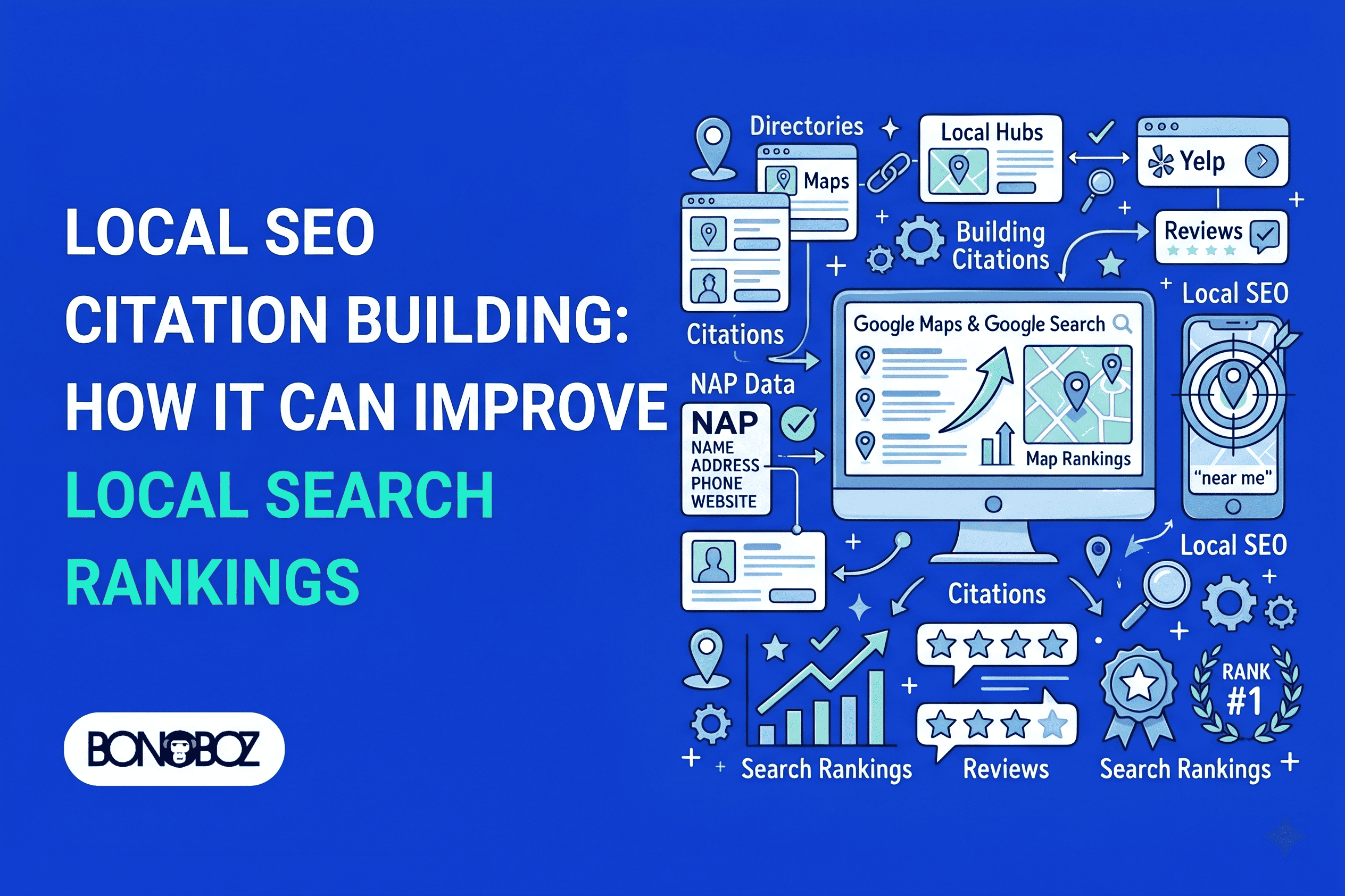
Local SEO Citations can make it easier for search engines and nearby customers to verify your business, though no directory listing guarantees a higher ranking. If you run an Indian SME or a growing local brand, you have probably seen agency proposals promising “500 directory submissions” as a shortcut to the top of Google. In reality, accurate business details help ready-to-buy customers find and contact you in your area, while inflated listing counts mostly just pad monthly reports. At Bonoboz, we follow this exact, accuracy-first process for all of our SEO clients because reliable business data leads to real enquiries, not vanity metrics.
NAP consistency means keeping your business name, address, and phone number accurate and aligned wherever customers or search engines look for you. When someone needs a nearby clinic, retail store, or repair service, conflicting phone numbers or an outdated address turn a simple search into a dead end. A working phone line and a clear physical address make it straightforward for people to call, visit, or compare options, while giving search engines a dependable picture of your business.
Useful Local Citations support customer trust, but rankings still depend on factors outside your control, most notably where the person searching is standing at that moment. This guide walks through how to audit, build, and maintain the listings that actually matter without treating directory volume as a prize. Start by treating data accuracy as the real goal, not a guaranteed position in search results.
What Local SEO Citations Can and Cannot Do for Rankings
A clean, consistent citation profile supports local visibility, but it will not force your business into Google’s top three map results. When your business appears with matching details across credible websites, customers can quickly confirm they have found the right company. Google evaluates local rankings using three core factors, relevance, distance, and prominence, rather than handing out ranking rewards based on how many forms someone fills out.
Google outlines these factors clearly in its local ranking documentation. Relevance measures how closely your business profile matches what the user is searching for. Distance looks at how far your location is from the searcher or the area typed into the query. Prominence reflects how established and well-known your business appears both online and offline.
How citations support verification
If you have been pitched Local SEO services before, you have likely heard two terms used interchangeably: what are seo citations, and what is local citations? Simply put, SEO citations are any online mentions or records that identify a business using core details like its name, address, and phone number. Local citations refer to those exact same business references when their primary job is to help nearby customers find and verify a business serving a specific area.
Thoughtful SEO Citation building keeps those public records aligned across the web. Business citations on dependable platforms give prospective customers another way to double-check your location, operating hours, or contact number before they commit to a visit. They help buyers reach out with confidence, while matching records reinforce a clear, consistent business identity for search engines.
Google does not promise that adding new directory listings will move you up a specific number of spots. A spotless listing also cannot override geography: if a searcher is ten kilometres away in another part of the city, Google will usually show closer competitors first. Treat Citation building as foundational support for your online presence, not a workaround for search context.
Why more listings do not guarantee rankings
Build citations to make your contact details reliable, not to buy your way up the search page.
Local SEO Citations help when a real customer checks your details or when an established platform contributes to your broader online prominence. By contrast, a stack of weak, auto-generated directory pages adds almost no value and often leaves customers confused about which phone number is active. Local rankings also fluctuate due to competitor activity, reviews, and website quality, not just listings.
Judge every listing by a simple standard: does it give the right customer a trustworthy way to identify and contact your business?
Structured and Unstructured Citations Serve Different Roles
A business directory displays your details in neat, labeled fields, whereas a local news article might mention your company inside an ordinary paragraph. The first is a structured local citation; the second is an unstructured mention. Both have a place in Local SEO, so use each for its intended purpose instead of treating one as a substitute for the other.
NAP covers three baseline fields: name, address, and phone number. On your own website, Google’s LocalBusiness structured data also allows you to mark up details like your business name and physical address in a format search engines can read without guesswork.
Structured directory profiles
Structured profiles live on directories and map platforms that use dedicated fields for your business name, address, phone number, working hours, and category. Customers can scan those fields in seconds instead of hunting through a block of text to find a phone number. These profiles also give your team a single, predictable place to update information when something changes.
Not every directory collects the exact same fields. One platform may display your full street address and landmark, while another focuses primarily on your phone number and website link. Complete each profile accurately within that platform’s rules, and always check the live public page after saving your edits.
Unstructured local mentions
Unstructured mentions appear naturally inside everyday content, such as a local newspaper feature, an industry association member list, a chamber of commerce page, or an event sponsorship announcement. The writer might mention your brand name and neighbourhood without publishing your full street address or phone number. Even so, that reference connects your business to a real local community or industry network.
While citations are online business references, not every useful reference includes all three NAP fields. A press mention is helpful third-party validation, not a replacement for maintaining your core directory profiles. Having citations across multiple sites gives customers more ways to discover you, while appearing across different formats tells a fuller story of your business.
Keep your structured profiles accurate and complete even when unstructured mentions add helpful local context.
Choose Indian Directories That Fit the Business
A neighbourhood restaurant in Bengaluru and an industrial equipment supplier in Pune should not use the exact same list of directories. Start with the platforms your actual buyers check, then verify whether each site supports your business category. Choose platforms based on audience fit, not the habit of clicking “submit” on every free listing site you find.
For most Indian businesses, a practical starting shortlist includes Google Business Profile, Bing Places, Apple Business Connect, Justdial, Mappls, and one or two credible industry-specific directories. Global sites like Yelp work well in certain markets, but they are rarely a priority for the average Indian SME unless you specifically serve international travellers or expats.
Google Business Profile, Bing Places, and Apple Business Connect serve as core map and search ecosystems. Justdial and Mappls are widely used across India by customers looking for local vendors, clinics, and service providers. How much value you get from each depends entirely on your category and target audience, not simply whether the site lets you create a free account.
A local cafe will naturally focus on food and dining discovery platforms. A diagnostic clinic should prioritize reputable healthcare directories, while an electrical or plumbing contractor benefits more from local trade associations and neighbourhood service platforms. Niche and regional directories work well when their visitors genuinely overlap with your service area.
Some platforms have rigid category lists or poor moderation that do not suit every business model. Before creating a profile, check whether real customers use the site, whether you can realistically keep the listing updated, and whether existing pages look trustworthy. A directory is not worth your time just because it accepts free submissions.
Pick platforms whose audience and business categories match how your customers actually buy.
Audit Existing Listings Before Adding More
Before you create a single new listing, search for your exact business name and phone numbers on Google. This is the quickest way to uncover old, incomplete, or duplicate profiles created by past agencies, former staff, or automated data aggregators. Always clean up existing records before pushing more business data onto the web.
Search your business name inside quotation marks, then run separate searches for your primary phone numbers, both with and without spaces or country codes. Compare what you find on live directories against the contact page on your own website. A profile can look completely fine inside your dashboard while an older duplicate still shows up in customer searches.
Find listings by source
Start by reviewing the main platforms you already know about, then dig into secondary directories and local mentions. Treat Google Business Profile and Bing Places as separate records if you maintain both. It is very common for an old office address or disconnected landline to stay live on secondary sites long after your Google profile has been updated.
Log every live URL you find, note whether your team has login access, and write down the exact mismatch. Record the source type as well, such as a map platform, general directory, or trade portal. A straightforward tracking sheet beats relying on memory or scattered browser bookmarks.
Compare each record against a canonical version
Establish one approved master version of your business name, address, and phone number to serve as your single source of truth. Compare every live listing against that master record, noting both missing fields and outdated details. Minor inconsistencies create real friction when a customer dials an old number or drives to a previous address.
Always complete this audit before starting any new local Citation building. If a profile is tied to an ex-employee’s email or a previous agency’s account, document that access gap right away instead of assuming you can edit it later. Keep your audit notes clear and factual so anyone on your team can act on them without guessing.
Lock in one verified reference version of your business details so every future check measures against the same standard.
Lock Down Business Details Across Profiles
Before editing any live listing, verify your business’s real-world name, full Indian street address, and active phone number. A clear internal checklist prevents errors when multiple team members or external partners touch your accounts. Always use the exact details customers see on your storefront and invoices, not a version stuffed with keywords for search engines.
Verify each of these items before reusing them across platforms:
- The exact business name printed on your signboard, bills, and customer materials
- Your complete street address, including building name, road, area, and the correct six-digit Indian PIN code
- Your active customer-facing phone number, formatted with India’s +91 calling code where appropriate
- Your official website URL, accurate operating hours, and the closest matching business category
Formatting requires common sense. One platform might automatically abbreviate “Road” to “Rd.” or format punctuation slightly differently while still pointing to the exact same location. That is harmless. What hurts you is changing the underlying business name, phone number, or address in ways that no longer match reality.
Google Business Profile may also display your fields in a different visual layout than Justdial or Apple Business Connect. You do not need to force every screen to look identical at the expense of accuracy. Citation management tools can help organize your records, but software cannot verify whether a phone line actually gets answered at your front desk.
Getting this baseline right underpins both seo citation building and your wider Local SEO work, because every update pulls from the same verified facts. Treat your phone number, address, and hours as customer-facing operations data, not trivial form fields. A single typo in a PIN code or phone digit can cost you a real lead.
Double-check that every contact detail connects to a real location or phone line a customer can actually reach.
Build Citations in a Controlled Sequence
A reliable citation-building workflow follows three stages: verify your core facts, complete your primary profiles, and then add only relevant secondary listings. Moving in a deliberate sequence prevents rushed mistakes and keeps account ownership clear. Sort out any questions around branch eligibility or address formatting before submitting anything.
Keep the process practical for a small team. You do not need complicated enterprise tools to start, a shared spreadsheet and a clear record of who owns each login will keep things organized. One well-maintained master sheet is far easier to manage than business details buried in old email threads.
Prepare one verified data sheet
Stage 1 is gathering your approved business information in a single document. Include your real-world business name, full address, phone numbers, website URL, operating hours, primary category, and short business description. Note who signed off on the details and the date they were last verified.
Assign a clear owner to every platform account and store login credentials in a secure password manager. Never leave passwords sitting in an open spreadsheet. If an employee moves on or you switch marketing partners, the business owner must still have direct recovery access to every profile.
Claim and complete core profiles
Stage 2 is claiming and completing your foundational profiles. Google Business Profile is the top priority for almost every Indian SME, alongside Bing Places and Apple Business Connect depending on your customer base. Follow each platform’s verification steps carefully, as verification methods vary by business type and account history.
Google’s support documentation explains how to verify a Business Profile and manage its information accurately. Fill out every required field carefully, and never guess when a form asks about storefront rules or service areas. Log what you submitted, when you submitted it, and who handled the verification.
Expand selectively and document submissions
Stage 3 is adding selected secondary and industry-specific listings. Maintain a simple submission log recording the directory name, live URL, submission date, account owner, and current status. If a directory rejects a submission or requests extra documentation, note that in the sheet instead of submitting duplicate forms.
A sensible citation workflow makes future maintenance easier rather than leaving you with a mystery trail of forgotten accounts. Update your tracking sheet as soon as a listing goes live or gets corrected. Clean, accurate records strengthen your Local SEO foundation by eliminating avoidable customer confusion, even if they do not promise overnight ranking jumps.
Document account ownership clearly so routine staff turnover never locks you out of your own business profiles.
Prioritize Sources by Relevance, Not Volume
One well-maintained listing on a platform your customers actually trust is worth far more than fifty neglected profiles on obscure directories. A worthwhile citation source passes three practical tests: local or industry relevance, genuine usefulness to buyers, and a straightforward way to keep details updated. High citation counts are neither an industry benchmark nor a guarantee of better rankings.
Relevance matters more than volume because a listing only creates value if it helps people who might actually buy from you. Google lists relevance as one of its three local ranking pillars, though that does not mean every niche directory acts as a direct ranking lever.
Local and industry fit
Ask whether the platform genuinely serves your city, neighbourhood, or industry. A regional trade association, local business chamber, or respected Indian industry portal often sends better-qualified enquiries to a specialized business than a generic national directory. Reaching a smaller, focused audience of real buyers beats appearing in front of thousands of irrelevant browsers.
Look at how people use the site. Are visitors actively searching for a service provider in their area, or is the page just a wall of automated links? Listings that match genuine local buying intent help customers find nearby businesses they can trust. Pages with zero connection to your market deliver little practical SEO value.
Editorial quality and maintenance burden
Check whether the directory enforces basic quality standards, displays accurate listings, and gives owners a clear way to edit outdated details. An unmoderated directory can display your old phone number or wrong working hours for years without letting you fix it. That creates more customer service headaches than marketing value.
Factor in the ongoing effort required to manage each account. If a platform frequently breaks edits or buries updates behind unresponsive support tickets, the maintenance cost outweighs the benefit. Clean citations support local visibility when they help buyers reach you, but sheer volume alone will never push you higher in search results.
Skip any directory that cannot be kept accurate or offers no realistic path to your target customers.
Fix Duplicates and Outdated Records
When two profiles exist for the same business location, start by identifying which record your business can officially verify and control. Duplicate listings split customer reviews, confuse search engines, and frequently display conflicting phone numbers. Maintain one approved, live record per eligible physical location in line with each platform’s guidelines.
If you operate multiple legitimate branches across different neighbourhoods or cities, never merge them into a single listing. Each eligible branch deserves its own accurate profile. Google Maps allows you to suggest edits or report duplicate places, and most major Indian directories offer similar merge or removal workflows.
Follow this straightforward cleanup sequence:
- Identify the accurate listing your business can officially verify.
- Confirm who holds login and recovery access to that profile.
- Update all business details on the primary listing you control.
- Report or request removal of the duplicate listing through the platform’s support flow.
Search engines cross-check business details to confirm which record represents a real-world location, while customers rely on that exact same data to call or navigate to your door. Duplicate removals often require manual platform review, so keep a record of your support tickets and submission dates. And never delete a valid listing for a separate branch just to make a spreadsheet look cleaner.
Always check the live public listing after an update instead of assuming an edit went through automatically.
Measure Visibility Without Chasing Vanity Metrics
If you have suffered from reporting fatigue, you know how frustrating it is to receive a 20-page PDF celebrating “45 new directory links” while your sales team says the phone has not rung all week. Instead of counting submissions, track whether real people are finding and interacting with your core profiles, and compare that against organic search visits over the same timeframe. Profile actions and website traffic measure different stages of buyer behaviour, so look at both side by side without treating a single week’s ranking shift as proof of cause and effect.
Google Business Profile insights track direct customer actions such as phone calls, direction requests, and website clicks. These numbers show whether your listing is actually helping nearby buyers take the next step, even though they do not capture offline word-of-mouth or walk-ins.
Google Search Console shows how your website performs in organic search, including local impressions and clicks. Review those website numbers alongside your profile interactions rather than mashing everything into a made-up “visibility score.” Local map visibility and organic website traffic work together, but they measure distinct user journeys.
Compare equal date ranges, such as 90 days before and 90 days after your citation cleanup, and account for other changes happening at the same time, like a website redesign, seasonal demand, or updated store hours. Multiple factors influence search visibility simultaneously.
A bump in local rankings on a Tuesday morning does not prove that one directory listing caused it. Search results shift constantly based on user location, personalization, and competitor changes. Use your data as a practical guide for what to fix next, not as a trophy to justify inflated retainers.
Avoid the Citation Mistakes That Weaken Trust
Adding extra keywords to your official business name on directory profiles makes your brand look spammy, not more relevant. Google’s Business Profile guidelines explicitly state that your profile name must reflect your real-world business name. Stick to the name customers actually see on your storefront, rather than cramming city names or services into the title.
Common mistakes that erode customer trust and trigger profile suspensions include:
- Stuffing city names or service keywords into your official business name
- Creating fake listings for virtual offices or areas where you have no physical presence
- Listing a phone number that rings unanswered or goes to an unmonitored inbox
- Submitting conflicting street addresses or PIN codes across different platforms
- Leaving old profiles untouched after moving offices or changing contact numbers
Google generally allows one profile per eligible physical location. Certain multi-practitioner clinics, dealerships, or distinct departments may qualify for separate profiles, provided they follow Google’s strict eligibility rules. Operating a genuine branch office is completely different from pretending a service area is a walk-in storefront.
Accurate names and addresses help nearby customers find you without second-guessing whether they have the right business. When reviewing your presence on Google Maps or Indian directories, compare what appears on screen directly against your real-world signage and stationery. Never assume a listing stays accurate just because it passed verification two years ago.
Match every profile name to the exact name customers see on your physical signboard and invoices.
Keep Citation Data Current as the Business Changes
Review your priority listings once a quarter, and update them immediately whenever a customer-facing detail changes. A quarterly audit is a sensible maintenance habit, not an excuse to leave a disconnected phone number or an old office address sitting online for three months. Whenever your operations change, update your core profiles right away.
Put a recurring quarterly reminder on your calendar to check the details customers rely on most. Moving to a new office, changing phone numbers, adjusting festive or weekend hours, or rebranding should trigger an immediate profile update across your master list. Google Business Profile and major directories allow you to edit core details whenever your business evolves.
Quarterly reviews catch slow data drift, but they never replace an immediate update after a real-world business change.
Keep a simple maintenance log noting the profile owner, recovery email, and last-reviewed date for Google Business Profile and your top directories. That single record clarifies who is responsible for making edits and ensures you never lose access to critical accounts. It also makes onboarding a new marketing hire or agency partner painless instead of turning into a hunt through old emails.
Consistent Local SEO Citations require light, ongoing upkeep because businesses do not stand still. A new branch number, updated website domain, or revised clinic timings can quickly make secondary listings outdated even after you fix your main Google profile. A predictable quarterly rhythm keeps your local presence accurate without turning directory management into a daily chore.
Assign one specific person to own the next quarterly review date and verify they can log into every priority account.
A Grounded Way Forward
Dependable local visibility starts with business details customers can trust wherever they find you. A small, well-maintained set of accurate profiles on platforms your buyers actually use will always outperform dozens of neglected directory listings. That disciplined approach reduces customer frustration and ensures people reach the right phone number and address every time.
At Bonoboz, this is the exact standard we apply across all of our SEO client accounts, focusing on verified data, clear ownership, and real customer enquiries rather than inflated submission counts. You do not need to overhaul fifty directories this week to see progress. Pick your single highest-priority profile today, verify every detail against your real-world signage, and assign one clear owner to keep it accurate.
FAQs
1. How many local citations does a small business need?
A small business should cover its core map platforms, such as Google Business Profile, Bing Places, and Apple Business Connect, alongside a handful of trusted Indian or industry-specific directories before considering anything else. There is no magic number of citations that guarantees better rankings. Focus on the platforms your customers genuinely use and that your team can realistically keep accurate. A tight list of ten dependable profiles beats eighty abandoned pages with outdated contact details.
2. How often should I check my business listings?
Review your priority listings once every quarter as a routine check, and update them immediately whenever you move locations, change phone numbers, adjust working hours, or rebrand. A quarterly review helps catch subtle issues like seasonal hour changes or third-party edits, while immediate updates prevent customers from calling a dead number or visiting an old address.
3. Do citations help if my business does not have a website?
Yes. You can build and maintain accurate business profiles on platforms like Google Business Profile and Justdial even if you do not have a website yet. Keeping your phone number, physical address, and working hours accurate allows local customers to call or visit you directly. If a directory includes an optional website field, simply leave it blank rather than pasting a placeholder link that does not represent your business.
4. Can I use a home address for a service-area business in India?
You can use a home address for verification where platform rules allow it, but you should hide the street address from public view unless your home is a staffed location where customers can walk in during business hours. Many home-based consultants, tutors, and repair technicians travel to their customers instead. In those cases, follow the platform’s service-area guidelines so you accurately display the neighbourhoods or cities you serve without listing a private residence as a retail storefront.
5. Should the business name include keywords such as a city or service?
No. Always use your genuine, real-world business name rather than adding city names or service keywords to try to manipulate search rankings. Google’s guidelines explicitly require your profile title to match how your business is known offline. Adding extra keywords looks untrustworthy to customers, violates platform rules, and frequently triggers listing edits or suspensions. Keep your profile name identical to your physical signboard and official documents.
6. Are paid directory placements necessary for local SEO?
No. Paid listings or sponsored directory packages are not required for effective Local SEO or accurate citation work. Evaluate any paid directory strictly on business merit: do your target customers actively use that platform, what do the contract terms cover, and can you keep your profile details updated? Paid visibility can occasionally make sense in competitive categories, but paying a listing fee alone will never guarantee phone calls, store visits, or higher organic rankings.
Related Articles:
- Why Bonoboz is the Best SEO Company for Business Growth?
- FAQ Schema for SEO: How It Works and How to Implement It
- SEO for Fashion Ecommerce: Strategies to Drive More Organic Sales

Rahul Mamtani Rahul Mamtani on LinkedIn
Rahul is an SEO Expert with over 6 years of experience in search engine optimization, helping businesses improve their online visibility, organic traffic, and search rankings. His expertise includes technical SEO, keyword research, on-page and off-page SEO, local SEO, and content optimization. He focuses on data-driven strategies and practical SEO solutions that help websites attract relevant audiences and achieve sustainable organic growth.