
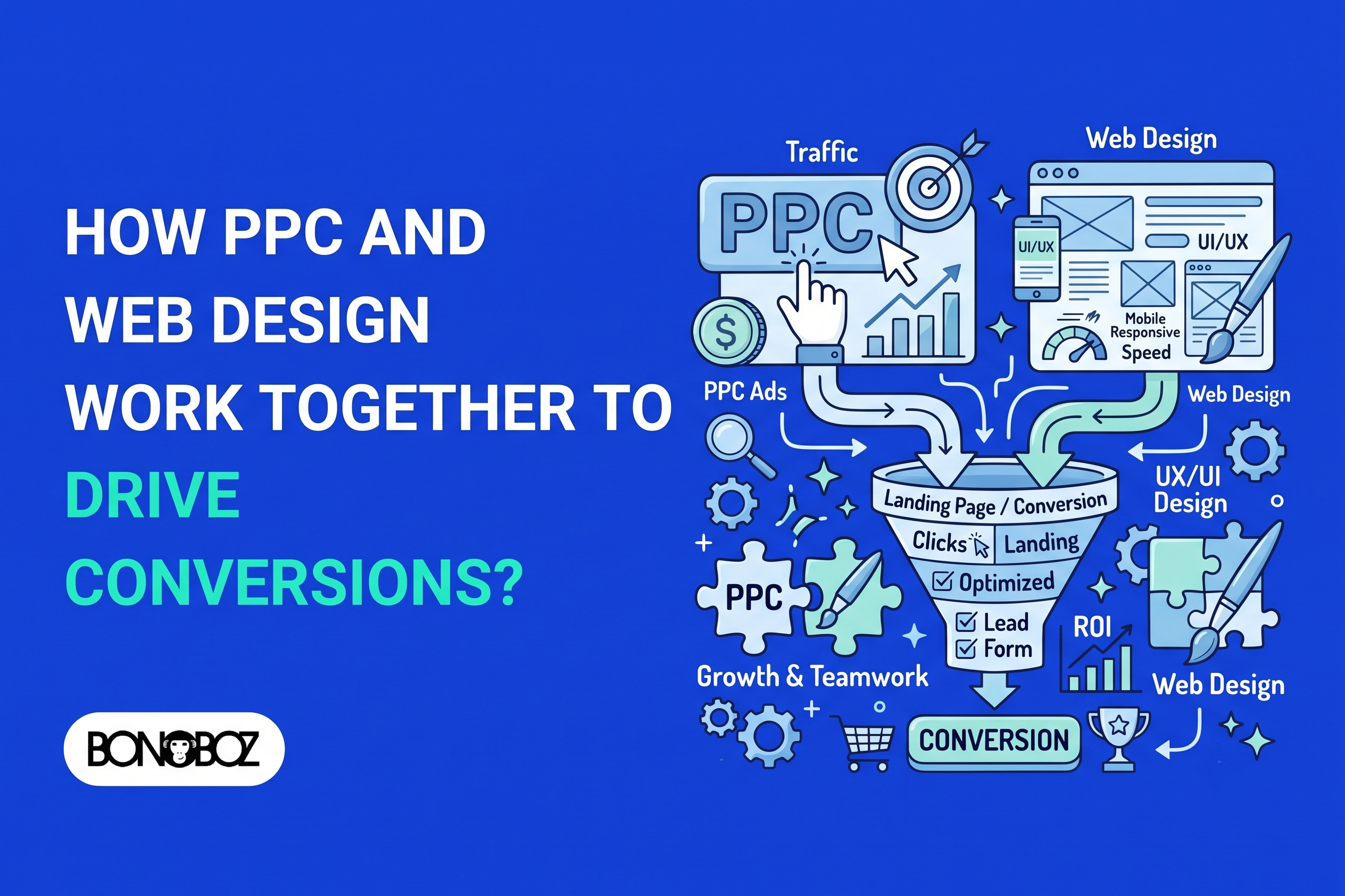
PPC advertising can bring interested people to a website, but design determines whether those visitors take the next step. For an Indian business, a conversion isn’t just an ad click, it means booking a doctor’s appointment, requesting a home repair quote, or completing an online purchase. An ad reaches a targeted audience based on search intent or user interest, but getting them to click is only the first step.
A conversion is a specific action, such as a form submission, phone call, or purchase. The conversion rate is the percentage of website visitors who complete that action. If the page a visitor reaches is slow, confusing, or generic, that paid click is wasted. A potential customer should never have to search through a complex menu just to ask about a product or service.
PPC and web design work best when the ad and website support one clear goal. At Bonoboz, we follow this exact connected approach for all our SEO and PPC clients, ensuring ad spend is tied directly to landing page performance rather than vanity metrics.
Keep the Ad Promise Consistent on the Page
Good ppc web design connects search intent directly to a landing page that answers the exact need advertised. If an ad promises a specific service, such as emergency dental care or bulk printing, the landing page must name and explain that exact service immediately. Visitors will not navigate through a broad homepage to find an offer they clicked on.
Professional Web Design Services shape page layouts, content structure, and calls to action so visitors instantly know what to do next. Behind the scenes, reliable Web Development Services build the technical functionality needed for conversions, such as fast-loading booking forms, clickable phone numbers, or streamlined checkouts. Whether these roles sit with one team or separate partners, the message and technical execution must match.
Use Page Behavior to Improve the Campaign
Agencies offering PPC Management Services often focus heavily on keyword bids, target demographics, and ad copy. Meanwhile, Website Design Services focus on site aesthetics, user navigation, and page layout. When these two areas operate in isolation, ad budgets get burned.
For example, if visitors leave a page within seconds of clicking an ad, the issue isn’t automatically poor ad targeting. The page itself may hide the offer or contradict the ad copy. Evaluating ad metrics in isolation hides landing page problems, so always review ad performance and page behavior together before altering a campaign.
What Happens Between an Ad Click and a Conversion?
Someone searching for a local plumbing service clicks a relevant search ad and lands on a service page. That click represents initial interest, but it does not guarantee an inquiry.
A click is not a lead. A PPC campaign selects who sees an ad based on search terms and audience criteria. Bids determine ad placement, while ad copy communicates the offer. Google Ads is a major PPC platform, but paid search is only part of the conversion path.
Five distinct stages determine whether a click leads to business revenue:
- Audience and keyword: Setting who to reach based on relevant search terms.
- Bid and display: Setting a bid so the platform displays the ad to prospective buyers.
- Ad view: The user reads the ad text and evaluates whether it meets their immediate need.
- Click and landing page: The user follows the ad link to the specific offer page.
- Conversion: The visitor completes the intended action, such as submitting an inquiry or calling the business.
Mismanagement at any point breaks the chain. Broad keywords can bring irrelevant visitors, while a cluttered landing page wastes high-intent traffic.
How Can Ad Copy Match the Landing Page?
An ad offering a free diagnostic check that leads to a generic corporate homepage leaves the visitor confused. That mismatch causes immediate drop-offs.
Aligning the keyword, search intent, ad copy, landing page headline, offer details, and call to action builds immediate credibility. It confirms to the user that they landed in the right place and gives them a clear path forward.
A search engine drives traffic through both paid search (PPC) and organic search listings (SEO). While SEO builds long-term organic visibility, paid search demands immediate messaging alignment because every click carries a direct cost. An ad promising “Same-Day AC Repair” must land on a page dedicated specifically to AC repair, complete with service areas, transparent pricing, and a simple booking option.
Consistent messaging reduces bounce rates, though it does not guarantee immediate profitability. Marketers must evaluate conversion rates alongside cost per click (CPC) and actual customer value to understand overall campaign health.
Which Page Elements Help Paid Visitors Convert?
A visitor can land on a relevant page and still abandon it if the next step requires effort or hunting. Clear visual structure guides the user toward taking action.
Make the Offer and Next Step Easy to Find
Display the offer, key benefits, and call to action immediately without forcing visitors to scroll excessively. Use explicit labels for action buttons, such as “Request a Callback” or “Download Spec Sheet”, rather than generic terms like “Submit”. Include practical trust markers near the offer, such as verified contact details, business credentials, or explicit service terms.
A high click-through rate (CTR) shows that an ad attracted interest, but CTR alone cannot measure business outcome. Marketers must track conversion rate and cost per conversion through tools like Google Analytics to evaluate actual lead generation.
Reduce Friction in Forms and Checkout
Inquiry forms should ask only for information needed to fulfill the initial request. For a consultation call, asking for a name and phone number is usually sufficient. Requiring additional details like company size or budget upfront increases drop-off rates, as visitors rarely want to share extensive data during early inquiries.
For e-commerce sites, keep the checkout path focused entirely on product selection, shipping details, and payment processing. Avoid adding distracting navigation elements or popups during checkout.
How Should Indian Businesses Plan for Mobile PPC Traffic?
In India, the vast majority of PPC clicks occur on mobile devices, often across varying network connections. A landing page that functions well on a desktop screen can fail completely on a mobile device if text is unreadable or form fields are cramped.
Always test landing pages on physical mobile devices rather than relying on desktop browser previews.
Five essential mobile checks before running PPC ads:
- Readable text: Ensure visitors can read all content clearly without manual zooming.
- Tappable controls: Make buttons and form fields large enough for easy thumb navigation.
- Fast action access: Place primary call-to-action buttons where they are visible immediately on mobile screens.
- Practical form inputs: Configure input fields appropriately (such as triggering numeric keypads for phone numbers).
- Screen size testing: Verify the end-to-end form or checkout path on common Android and iOS screen dimensions.
For e-commerce campaigns, test product selection, cart updates, and payment gateway redirects on mobile connections. For service businesses, submit test forms on a mobile device to confirm that inquiry notifications reach the sales team promptly. Increasing keyword bids will never fix an unusable mobile form.
Which Metrics Show Whether PPC Traffic Converts?
Campaign success relies on tracking concrete business outcomes, such as qualified inquiries, calls, or sales, rather than surface metrics like impressions or total clicks.
Without accurate conversion tracking, campaign reports only show ad spend, not business revenue. Set up conversion events before running campaigns.
- Impressions: Show how often an ad was displayed, indicating overall campaign reach.
- Click-Through Rate (CTR): Compares ad clicks to total impressions, showing ad copy relevance.
- Cost Per Click (CPC): Measures the average cost incurred for a single page visit.
- Conversion Count: Tracks total completed actions, such as forms submitted or purchases made.
- Conversion Rate: Calculates the percentage of total ad clicks that resulted in completed actions.
- Cost Per Conversion (CPA): Compares total ad spend against total tracked leads or sales.
- Return on Ad Spend (ROAS): Evaluates total revenue generated against ad spend for e-commerce campaigns.
Analytics platforms help track user behavior, but they must be configured correctly. An ad platform reporting a “conversion” does not guarantee that the resulting lead was qualified or resulted in actual revenue. Always cross-reference campaign metrics with internal sales data.
How Can Testing Improve Campaign Performance?
When a campaign drives clicks but yields few leads, run controlled tests on specific page elements rather than overhauling entire campaigns at once.
Test one variable at a time, such as a page headline, form length, or button placement, while keeping targeting and offer details constant.
Useful testing areas include:
- Simplifying form fields to reduce user friction.
- Testing direct calls to action versus softer inquiry prompts.
- Adjusting headline alignment to match specific high-volume ad copy.
Document when changes were made, what was modified, and the resulting metrics. Avoid drawing conclusions from small sample sizes or minor statistical fluctuations. Systematic testing isolates what actually drives conversion improvements.
Who Should Handle PPC and Website Changes?
A common campaign breakdown occurs when ad promises change but landing pages remain untouched. Establishing clear operational ownership prevents mismatched messaging and wasted ad spend.
Assign Clear Ownership for Ads and Page Edits
Define who owns campaign targeting, page updates, tracking scripts, and pre-launch reviews:
- Internal Marketers / PPC Specialists: Manage keyword strategy, audience targeting, ad copy, and campaign bids.
- Web Developers / Designers: Maintain page loading speeds, user interfaces, mobile responsiveness, and technical form setups.
- Management / Business Owners: Define clear sales goals and verify lead quality.
Coordinate Approval, Tracking, and Launch Checks
Before pushing new PPC campaigns live, complete a simple pre-flight checklist:
- Verify that the landing page headline and offer match active ad copy.
- Confirm that conversion tracking fires accurately upon form submission or checkout.
- Test that lead notifications reach the responsible sales representative immediately.
Do not launch new ad offers until landing page changes and tracking setups are verified.
What Can Break the Link Between Ads and Conversions?
When PPC campaigns fail to generate expected leads, systematically review technical and operational failure points before assuming paid search is ineffective for your market segment.
Review these five primary failure points:
- The ad copy promises one offer, but the landing page displays another.
- The page loads slowly or breaks on mobile devices.
- Form fields or call buttons fail technically during submission.
- Conversion tracking is misconfigured, hiding actual lead volume.
- Broad keyword targeting brings visitors searching for unrelated services.
Work through technical and messaging checks systematically, resolve verified issues, and track performance changes before raising ad budgets.
Conclusion
Paid search clicks create an entry point, but clear, functional web design turns those clicks into measurable business outcomes. Aligning keyword intent, ad messaging, mobile usability, and accurate tracking is essential for sustainable digital marketing.
Before increasing ad budgets or adjusting bid strategies, select one active campaign and evaluate the entire user path. Verify that the ad copy matches the landing page, test the inquiry form on a mobile phone, and confirm that conversion tracking works accurately. Fix immediate friction points first, real growth comes from building a reliable conversion path, not spending more money on broken pages.
Frequently Asked Questions
1. How much should an Indian business spend on PPC?
There is no fixed minimum spend. Budgets depend on industry competition, average cost per click (CPC), and business capacity to fulfill leads. Start with a test budget that generates enough click data to measure conversion rates accurately before scaling ad spend.
2. How long does it take to know if a PPC campaign is working?
Timeline depends on click volume and user conversion cycles rather than a fixed number of days. High-volume consumer campaigns can yield actionable data within two weeks, whereas niche B2B campaigns with lower search volumes require more time to accumulate enough data for reliable evaluation.
3. Can I send Google Ads traffic to my homepage?
You can send traffic to a homepage if your ad promotes general brand awareness. However, if your ad promises a specific product, discount, or specialized service, sending visitors to a generic homepage increases friction and lowers conversion rates. A dedicated landing page is generally far more effective.
4. Do PPC and SEO need separate landing pages?
Not necessarily. A well-structured page can rank organically through SEO while serving as an effective destination for PPC ads, provided the content matches visitor intent and includes a clear call to action.
5. Why are my PPC clicks not turning into leads?
Common causes include disconnects between ad promises and landing page content, slow mobile load times, overly long inquiry forms, broken conversion tracking, or overly broad keyword targeting. Test the landing page and form submission process directly to locate friction points.
6. Should I test ad copy or landing page changes first?
Start with the most obvious point of friction. If ad CTR is high but page bounce rate is also high, test landing page messaging and form simplicity first. Test one variable at a time so you can isolate which change improved performance.
Related Articles:
- Google Search Ads vs. LinkedIn Ads: B2B Display Ad Showdown
- UX and Web Design Trends to Boost Conversions.
- Best Way to Use Display Ads, Grow Your Brand, and Boost Sales
