
How Long Does SEO Take to Deliver Measurable Results?

Rahul Mamtani
SEO usually takes several months to generate meaningful business results, and the exact pace comes down to your website’s current health, your competition, and how quickly actual changes go live. Investing in SEO Services in India can build steady, high-intent search visibility, but consistent, well-prioritized execution matters far more than a promised quick win.
If you are a business owner trying to plan a marketing budget, set lead targets, or time a product launch, you need a realistic timeline, even when nobody can give you an exact date. Search engines work on a timeline of months, not days. A sensible SEO plan sets clear milestones early on and tracks whether search visibility actually turns into qualified visits and sales enquiries. That evidence matters far more than hitting rank one for a single keyword. If an agency promises you a fixed date for top rankings, treat it as a sales pitch to question, not a number to build your budget around.
How Long Does SEO Usually Take to Show Results?
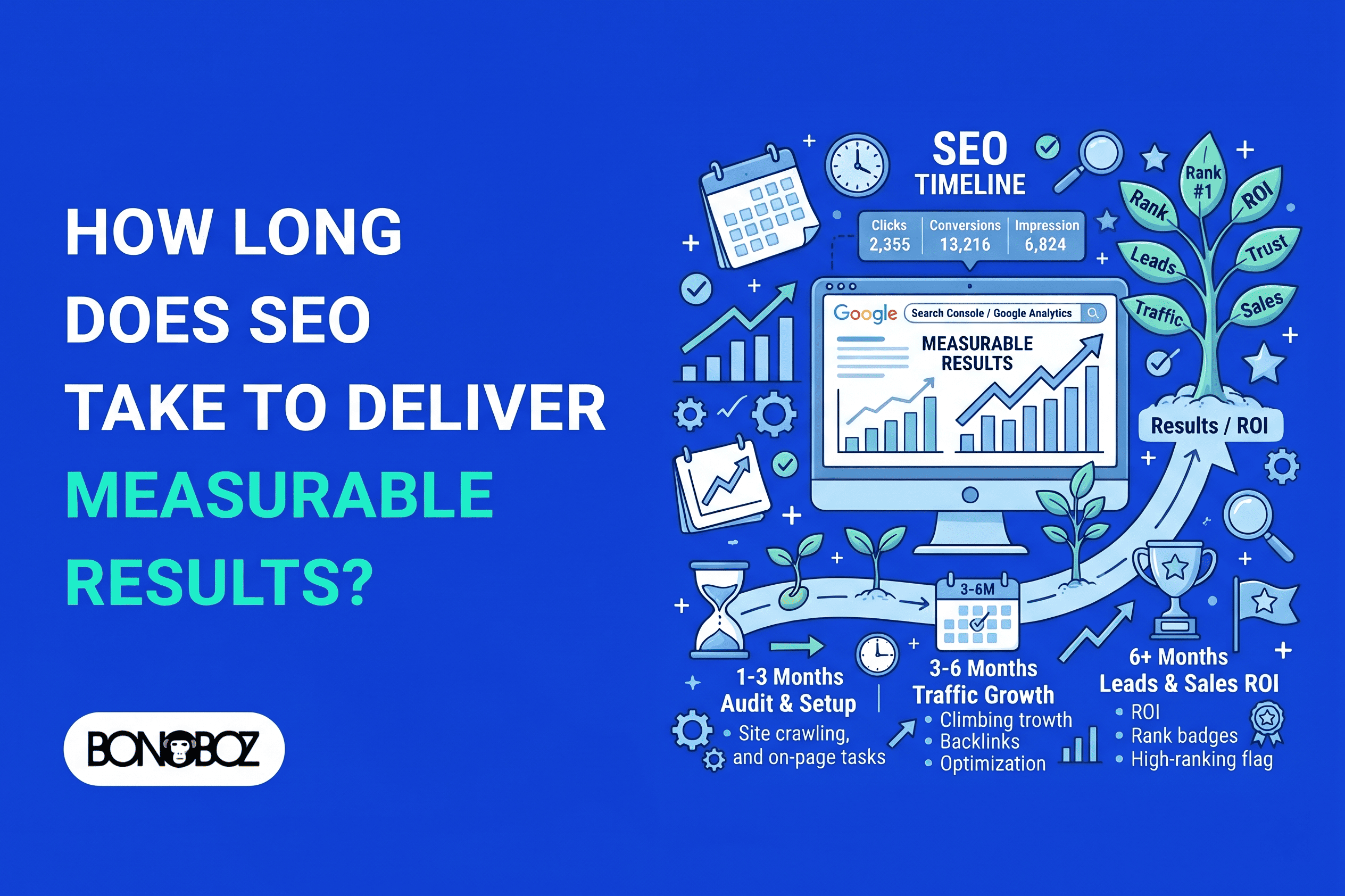
A practical planning benchmark is 3 to 6 months for early movement and 6 to 12 months for meaningful commercial results. That timeline can be shorter if you are trying to improve one specific, well-established page rather than an entire website.
Some pages start climbing in search results weeks before your organic traffic or lead count shows a lasting shift. Google Search Central notes that changes can take anywhere from a few hours to several months to reflect, and its SEO Starter Guide recommends waiting a few weeks before judging the impact of an update. These ranges are planning guidelines, not guarantees. A brand-new website or a business competing in a crowded market can easily take longer than 12 months.
Use the 3 to 6 month window to look for early signs of life, and the 6 to 12 month window to judge real business return, without treating either range as a hard deadline.
A narrow, low-competition search query can respond faster when an existing page already answers it well. That exception does not mean every keyword will move at the same speed. A realistic timeline depends on the specific page, the query, and the depth of the improvements made, not simply the date you signed a contract. Google does not operate on a fixed ranking schedule.
Many agencies try to prove how fast SEO works by sending screenshots of minor ranking shifts. Moving from position 45 to position 18 is a sign of progress, but it will not pay your bills if nobody clicks that far down the page. Early SEO progress often looks like better visibility before your phone starts ringing. Always compare performance against where you started, and remember that a rank change alone is not a business outcome.
What Affects the Timeline for SEO Services in India?
SEO progress becomes clear only when you connect a change on your website to a shift in search visibility, site visits, and actual leads. If you are tired of reading 30-page monthly reports filled with green arrows that do not match your bank balance, separate your tracking into three buckets: visibility, visits, and outcomes.
Google Search Console reports “average position,” which is simply the average rank of your pages across all impressions in a given period. That metric helps you see if a page is gaining traction, but it is not a business result.
Search visibility, qualified traffic, and business outcomes
Visibility comes down to impressions and average position, whether your page appears on Google and roughly where it sits. Clicks tell you whether searchers actually choose your link. In Google Analytics 4, organic sessions show how many visits started from unpaid search.
Outcomes are qualified enquiries, phone calls, demo bookings, or completed purchases. A page can rank at the top for a high-volume keyword and still fail if it attracts students, job seekers, or bargain hunters instead of real buyers. The only useful test of SEO performance is whether it reaches people who can actually become your customers.
Google Search Console tracks what happens on Google (impressions, clicks, click-through rate, and average position). Google Analytics 4 tracks what people do once they land on your site. They answer different questions, so you need both to see the full picture.
A baseline that makes change measurable
Before touching a single page, record where your numbers stand today. Once work begins, compare clean, like-for-like timeframes, such as two consecutive 28-day periods. Search demand in India shifts noticeably around festive seasons, fiscal year-end, and industry cycles, while a website redesign or broken tracking tag can distort your numbers overnight.
Sitewide averages can also be misleading. One core service page might be losing traffic while an old blog post spikes, making your overall graph look flat. Review your key pages and target queries individually alongside the sitewide numbers so you know what is actually working and what needs attention.
Healthy progress usually follows a sequence: a page earns more impressions, then more clicks, and eventually more qualified enquiries. Each page moves at its own pace, so keep your reporting windows and definitions consistent every month.
Why New Websites Often Need Longer
If you have launched a new domain, your website has to earn basic discoverability before it can compete for buyer-intent keywords. Google has to find, crawl, index, and evaluate your pages, and delays at any of these steps will stretch your timeline.
Crawling is when Google discovers and reads your page. Indexing is when Google decides the page is worth storing in its database. Ranking only happens after that, when Google decides your page is a good match for a specific search. On a new domain, Google takes time to work through these steps, so a quiet first quarter does not mean your content is broken.
Run through these basic checks to spot common roadblocks early:
- Confirm that your important pages are not accidentally blocked from search engines.
- Check each priority URL inside Google Search Console’s URL Inspection tool.
- Add clear internal links so both visitors and Google can reach your main service or product pages easily.
- Make sure each page serves a distinct purpose rather than repeating the same pitch across multiple URLs.
A 3 to 6 month benchmark for early traction is rarely realistic for a brand-new domain. Redesigning an established site with years of history is very different from starting from zero, though sloppy website migrations can still temporarily wipe out existing rankings. Always verify that your core pages are actually indexed before assuming your content has failed.
Technical SEO and Content Changes That Shape Timing
Technical fixes clear the path for search engines, while genuinely helpful content gives buyers a reason to stay and enquire. However, ticking a task off an agency checklist is not the same as earning higher rankings. First, the fix has to be implemented properly on your live site, and then Google has to recrawl and re-evaluate the page.
Google treats crawling, indexing, and ranking as separate systems. Cleaning up technical errors makes your site easier to access and use, but a clean technical audit alone will not push a weak page to the top of search results.
Technical fixes remove barriers to discovery
Technical SEO ensures search engines can reach and index your important pages without hitting dead ends. It also covers mobile usability and page speed, which matters heavily in India, where most users browse on mobile networks. Core Web Vitals tracks three practical parts of user experience: Largest Contentful Paint (loading speed), Interaction to Next Paint (responsiveness), and Cumulative Layout Shift (visual stability).
These metrics help you spot friction that makes visitors hit the back button. A good practitioner will point out which specific issue is costing you visitors or blocking Google, rather than obsessing over hitting a 100/100 speed score for the sake of it.
Useful content earns relevance and trust
Good content matches what the buyer is actually looking for, answers their questions with real depth, and guides them naturally to the next step. If an older page no longer reflects your pricing, process, or market reality, update it.
Publishing four generic blog posts every month just to show “activity” does not speed up SEO. Adding thin pages that reword existing content only clutters your site. Judge every page by whether it helps a potential customer make a decision, not by your monthly word count.
Even when a team works quickly, SEO takes time to compound. Focus your budget on fixing real access issues and improving the pages closest to revenue.
How Competition and Search Intent Affect Rankings
A specific, low-competition question with a clear answer can rank relatively quickly. A broad commercial keyword, like a core B2B service or popular consumer product, puts you up against established competitors, marketplaces, and directories that have spent years building authority.
A narrow informational query needs a direct, helpful answer. A commercial search puts your page side by side with detailed comparison guides and established sellers. Because the competitive landscape changes from one keyword to the next, a single timeline cannot apply to your whole website.
Search intent simply means what the person typing into Google actually wants to accomplish. It usually falls into three buckets:
- Informational: Looking to learn something or solve a problem.
- Navigational: Looking for a specific company, brand, or website.
- Transactional: Ready to buy, request a quote, or book a service.
A page can include your exact target keyword and still fail to rank if it misses the dominant intent. If everyone searching a term wants to compare service packages and pricing, a 1,500-word history lesson on the industry will not rank. Stuffing keywords into the text cannot fix a mismatch in intent.
Even for your own brand name, search results can sometimes show outdated listings, old press releases, or incomplete pages. Look at the live search results for every priority keyword before estimating how much work it will take to compete.
Local SEO Timelines for Indian Businesses
If your business serves customers in specific cities or neighbourhoods, you can often win visibility in Google Maps and local search packs well before your broader organic rankings mature. Local results depend heavily on where the user is standing when they search, meaning two people in different parts of Mumbai or Bengaluru may see completely different results.
Google’s Business Profile guidelines highlight three core factors for local rankings: relevance, distance, and prominence. Distance is how close you are to the searcher, while relevance and prominence reflect how well your profile matches the query and how established your business is locally. Maps listings and standard organic results work differently, though both bring local buyers.
Keep your Google Business Profile accurate, up-to-date working hours, real addresses, correct phone numbers, and clear service lists. Make sure those details match your website and local directories. Dedicated location pages on your site can also explain what you offer in the specific areas you cover.
Steady, genuine customer reviews and local mentions carry real weight. An honest SEO Agency in India will build your local presence around real business operations, never fake virtual addresses or spammy doorway pages.
If you run a service-area business, list only the cities or zones you actually serve. Creating dozens of copy-pasted pages for cities where you have no presence confuses customers, hurts trust, and risks profile suspension.
A Practical Measurement Plan for the First Year
A sensible first-year SEO plan starts by documenting your baseline, then tracks whether early search visibility turns into qualified traffic and leads. Use a 30, 60, and 90-day review rhythm to keep execution accountable, not to demand unrealistic revenue targets in month two.
Google Search Console shows how you appear in search, while Google Analytics 4 shows how those visitors behave on your site. Used together, they connect daily SEO work to real business numbers without expecting every metric to jump overnight.
Establish the baseline and clear technical blockers
In the first 90 days, lock down your baseline data. Verify that conversion tracking works properly, audit your top revenue pages, and keep a log of every technical or content change pushed live. Without that log, you will never know whether a traffic jump came from an SEO fix or a seasonal spike.
Compare clean 28-day windows when reviewing short-term movement, and note any major website updates or market shifts alongside your numbers.
Track meaningful gains through months four to twelve
Between months 4 and 12, review impressions and clicks alongside qualified organic visits and lead conversions. Growing traffic only helps your business if those visitors match your ideal customer profile and budget tier.
If movement stalls by month six, diagnose the bottleneck: is Google not indexing the pages, is the content missing buyer intent, is the competition far stronger than expected, or are approved recommendations still sitting unimplemented? Waiting passively will not fix a broken page or an unshipped update.
How to Judge an SEO Agency’s Timeline Claims
A credible timeline explains the exact work planned, the assumptions behind it, and what evidence you will review together. Guaranteed ranking dates are a red flag, Google explicitly states that nobody can pay for or guarantee organic search placement.
An estimate is still helpful when it is tied to clear dependencies. When evaluating an SEO Company India offers no shortage of agencies promising overnight rankings, so look for a partner offering SEO services in India that lays out its roadmap transparently enough for you to verify the work.
Ask any agency these five questions before signing a contract:
- Which specific pages and search queries will you prioritize first, and why?
- What exact deliverables are included each month?
- What dependencies require input or approval from our internal team or developers?
- How will you measure progress beyond keyword rankings?
- When will we review the initial assumptions and adjust the plan if needed?
Clear answers show whether the team has tied its timeline to actual tasks. Once changes go live, Search Console will show shifts in impressions, clicks, and average position. While those numbers are only the first step, they give you concrete evidence to discuss.
Before committing to an SEO company in India, ask how the timeline changes if your internal team is slow to approve content or push developer updates. A reliable partner names the pages, the tasks, and the review dates upfront, and puts its assumptions in writing so you can hold both teams accountable.
What Can Speed Up Progress Without Risking It
The safest way to see faster results is to remove real technical roadblocks and improve high-intent pages that already get some traction. Moving faster on implementation shortens the time it takes to test and measure changes, even though nobody can force Google to rank a page faster.
Start by fixing crawl or indexing errors on pages that matter to your business. Removing a technical block makes a page eligible to show up in search, which is the first hurdle to clearing before it can compete for clicks.
Next, look at important service or product pages that already earn impressions on page two of Google. Sharpening the copy to answer buyer objections clearly, improving the page layout, and adding internal links from relevant pages on your site can often nudge those pages onto page one faster than starting from scratch. Make sure the content reflects your actual expertise rather than fluff written purely for algorithms.
Buying cheap backlink packages or using automated link schemes might look like a tempting shortcut, especially when budgets are tight. Google’s spam policies actively target manipulative link building, and a manual penalty or algorithmic drop can wipe out your visibility overnight. Sustainable speed comes from sharp execution, not risky shortcuts.
Why SEO Isn’t Like Paid Search
Paid search lets you buy immediate visibility for as long as your budget runs, while organic search requires earning placement over time. Google Ads puts you in front of buyers the day your campaign goes live; organic rankings cannot be bought per click.
If you have a seasonal sale, a new product launch, or an urgent need to keep your sales pipeline full this month, paid ads are the right tool. SEO takes months to build momentum and cannot be switched on like a tap. Both channels solve different problems.
Over time, a solid SEO foundation compounds, good pages continue bringing in qualified leads without you paying for every single click. Even then, rankings are never permanent; competitors improve their sites, customer habits shift, and search engines update their systems, so ongoing maintenance is always part of the equation.
For most growing businesses, running Google Ads while building organic search gives you immediate lead flow today while lowering your blended customer acquisition cost over the long run.
You can combine both channels sensibly in three ways:
- Use Google Ads for immediate lead generation, launches, and time-sensitive offers.
- Build strong organic pages around core services and buyer questions you answer best.
- Judge each channel on its own timeline and specific business goal.
Treat SEO as a long-term business asset rather than a short-term ad campaign, and align your expectations with how each channel actually works.
How to Set Expectations With Your SEO Team
Base your expectations on completed work, early search signals, and real business goals, not a single keyword rank or an arbitrary deadline. A 90-day check-in should confirm whether the agreed work went live and whether early indicators are moving in the right direction.
At Bonoboz, this is the exact framework we follow for all of our SEO clients. Before starting, we align on priority revenue pages, clear task ownership, realistic reporting cadences, and the specific business conversions that matter, whether that is qualified B2B enquiries, store visits, or online orders.
A recommendation only counts as progress once it is live on your website and verifiable.
That distinction is where many agency relationships break down. If a writer drafts a page or an SEO team sends a technical document, but your developer takes two months to upload it, the SEO clock has not truly started. Counting “tasks sent” instead of “changes live” creates false expectations and reporting fatigue.
Use your 90-day review to ask three straightforward questions: what actually went live, what early data moved, and what is blocking the next step? One quiet monthly report is not a reason to scrap a sound strategy, just as one lucky spike is not proof that the job is done. Keep the focus on specific business outcomes, like qualified leads on your highest-margin service page, and clear the bottlenecks between reviews.
Conclusion
Plan for several months of steady, focused SEO work, and judge your return using metrics tied to your actual business. A 3 to 6 month window for early traction and 6 to 12 months for meaningful commercial results is a realistic benchmark, provided you treat it as a planning guide rather than a guaranteed date.
Use a structured 90-day review to verify that work has shipped and early visibility is building. Rely on Google Search Console to track search activity and Google Analytics 4 to measure real site behaviour and enquiries, keeping your eyes on qualified leads rather than vanity metrics.
Start simple: lock in your baseline numbers in Search Console and GA4, pick your highest-priority commercial pages, and put a 90-day review on the calendar to judge real execution and early search signals.
FAQs
1. Can SEO show results in three months?
Yes, early signs like higher impressions and upward rank movement can show up within 3 to 6 months, though consistent lead flow by month three is never guaranteed. Individual pages targeting specific, lower-competition queries often move faster than the rest of the website. Track whether those early clicks come from qualified buyers and compare them against your starting baseline.
2. Does publishing more pages make SEO work faster?
No. Pumping out extra pages just to hit a monthly quota does not speed up results. Every page on your site needs a clear purpose and should answer a distinct customer question better than what is already out there. Ten focused, genuinely helpful pages will outperform fifty repetitive, thin articles that compete against each other.
3. How often should I check SEO performance?
Check your analytics occasionally to make sure nothing is broken, but base your decisions on monthly reviews using consistent 28-day periods. Daily rank fluctuations are normal noise and tell you very little about business health. Review Search Console and GA4 side by side each month, and keep notes on any website changes or seasonal shifts that might explain sudden swings.
4. Can rankings fall after an SEO update?
Yes, rankings can dip temporarily after a site update, a change in competitor activity, or a Google algorithm update. Before reacting, look at the exact page and keyword that dropped rather than panicking over a sitewide average. Verify that the recent update went live without technical errors, and give it a full 28-day cycle to settle before changing direction.
5. Can I run SEO and Google Ads at the same time?
Yes, and for many SMEs, running both together is the most practical approach. Google Ads brings immediate enquiries while your organic presence builds momentum over several months. Running paid ads does not directly boost your organic rankings, so keep their budgets and goals separate, use ads for immediate pipeline and SEO for long-term, compounding visibility.
6. Should I target keywords across all of India or focus on one city?
Let your actual service footprint dictate your keyword strategy, not raw search volume. If you only serve clients in Ahmedabad, Pune, or Delhi NCR, focus on local SEO and location-specific pages for those exact areas rather than wasting budget on national terms you cannot fulfil. If you ship nationwide or serve clients across India remotely, build broader national pages alongside key regional hubs where you actively do business.
Related Articles:
- Local SEO Citation Building: How It Can Improve Local Search Rankings
- Why Bonoboz is the Best SEO Company for Business Growth?
- FAQ Schema for SEO: How It Works and How to Implement It
Rahul Mamtani Rahul Mamtani on LinkedIn
Rahul is an SEO Expert with over 6 years of experience in search engine optimization, helping businesses improve their online visibility, organic traffic, and search rankings. His expertise includes technical SEO, keyword research, on-page and off-page SEO, local SEO, and content optimization. He focuses on data-driven strategies and practical SEO solutions that help websites attract relevant audiences and achieve sustainable organic growth.