
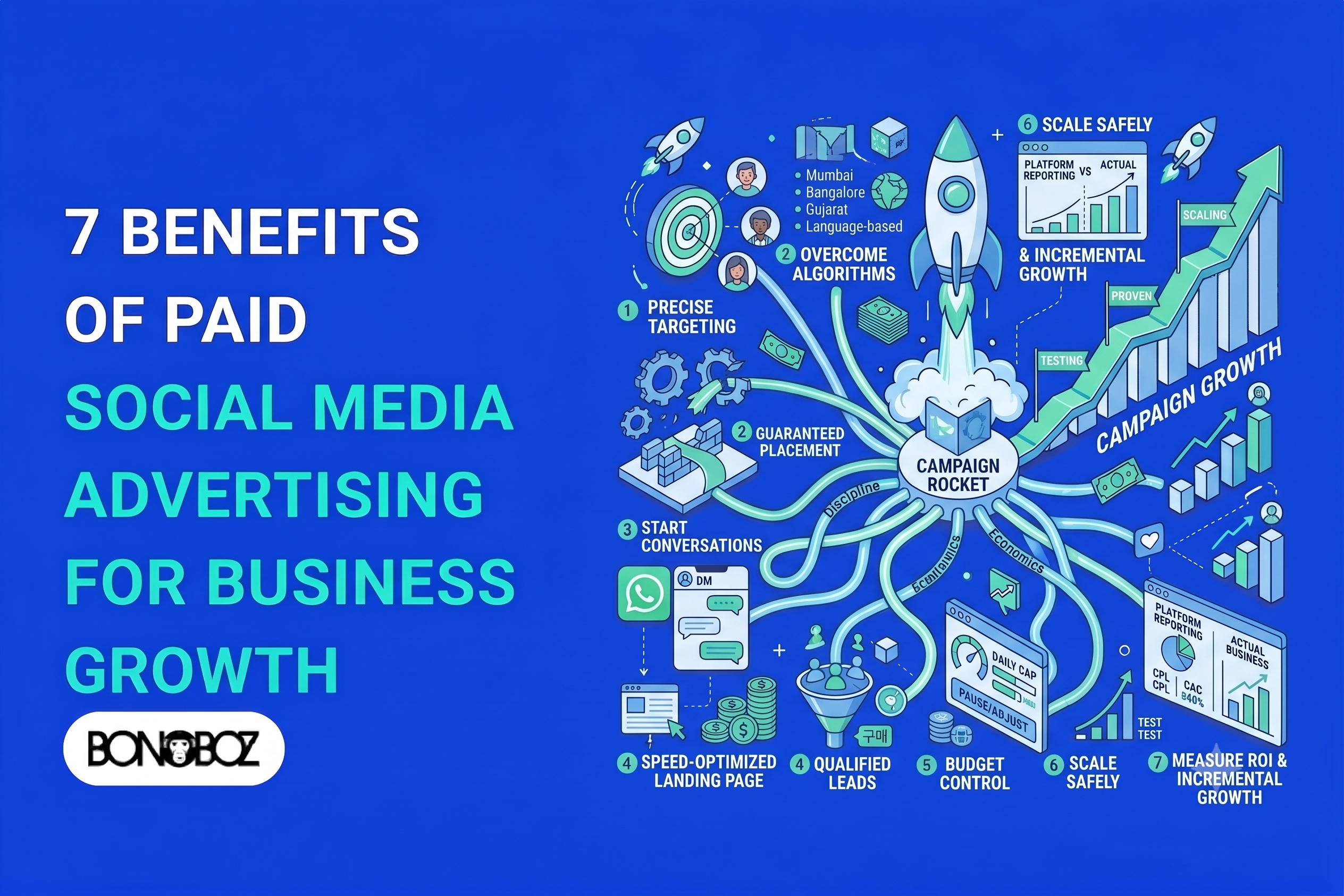
Most Indian SME owners we speak with at Bonoboz are tired of digital agencies making wild promises. You’ve likely been told that a few organic posts and generic “growth hacks” will magically fill your sales pipeline. The reality is harsher: social media platforms are commercial businesses. Their algorithms actively restrict organic brand reach to force businesses to buy ad space.
If you want your business to grow predictably, relying solely on organic posts is no longer viable. Paid social media advertising isn’t a magic button that creates demand out of nowhere, but when executed with discipline, it is a reliable engine for audience distribution. Understanding the real benefits of paid social media advertising helps you spend money where it impacts your bottom line, rather than wasting budgets on vanity metrics.
Key Takeaways
- Stop relying solely on organic algorithms that restrict your brand’s reach.
- Use precise demographic and regional targeting to reach real decision-makers across India.
- Focus on qualified landing page traffic and actual leads, not just likes and comments.
- Maintain control over daily ad spend to avoid burning cash on unproven campaigns.
- Combine client testimonials and regional messaging to build trust efficiently.
- Distinguish between platform-reported attribution and actual incremental business revenue.
Why Paid Social Media Advertising Matters for Business Growth?
Organic social media creates a place for your existing customers to validate your business. However, organic content rarely drives acquisition at scale anymore. The real benefits of paid social media lie in predictability. Paid ad spend buys guaranteed distribution so your message reaches prospective buyers who have never heard of you.
How Paid Social Campaigns Complement Organic Social Media
Organic content builds trust once someone finds you. Paid campaigns handle the discovery phase. Instead of hoping the algorithm shows your post to prospective buyers, ad spend ensures your best offers hit targeted feeds consistently.
- Broadens distribution for content that already proved effective organically.
- Delivers time-sensitive promotions and product launches to targeted non-followers.
- Gathers actionable audience response data to refine product messaging.
- Ensures consistent market visibility even when organic platform reach drops.
Why Social Media Advertising Fits Indian Consumer Journeys
Indian buyers rarely make immediate high-ticket purchases on their first contact with an ad. They compare options, seek social proof, and prefer messaging in their regional language. Paid campaigns allow you to nurture these prospects repeatedly across their buying journey.
Reaching Mobile-First Social Media Users
In India, the entire buyer lifecycle happens on mobile devices. Social ad formats are built for fast mobile interactions, letting users go from seeing a product to submitting an inquiry or messaging your team directly on WhatsApp or DMs. This ease of response is one of the distinct benefits of paid advertising on social media.
Supporting Local, Regional, and National Business Goals
Whether you operate a single manufacturing unit in Gujarat or deliver services across major Indian metros, paid media scales to your footprint. You can run hyper-local ads within a tight radius or execute national campaigns tailored by region.
1. Reach a Wider Audience Beyond Organic Limits
Relying on your current follower base limits business growth to word-of-mouth. Paid ads allow you to bypass these limits and put your business in front of new prospects daily.
Expand Visibility Across Relevant Social Platforms
Not every platform makes sense for every business. Allocate budget based on where your buyers actually spend their time:
- Instagram: Ideal for visual products, consumer brands, and targeting younger demographics.
- LinkedIn: Essential for B2B services, high-value consulting, and corporate decision-makers.
- Facebook: Offers wide demographic reach, cost-effective volume, and strong community options for mid-market audiences.
Overcome Social Media Algorithms and Limited Organic Reach
Platforms prioritize personal user content over corporate announcements. One of the main advantages of social media advertising is bypassing algorithm filters to secure guaranteed placement in user feeds.
| Feature | Organic Reach | Paid Reach |
| Visibility | Restricted by platform algorithms | Guaranteed ad placement |
| Audience | Existing followers & mutuals | Highly targeted new prospects |
| Control | Low control over who sees posts | High control over delivery and budget |
Use Paid Ads to Reach New Prospects
Running structured ad campaigns introduces your product or service to users who match your ideal buyer profile but aren’t actively searching on search engines yet.
Build Awareness Beyond an Existing Following on Social Media
To gain market share, you must continuously capture new mindshare. Paid media keeps your brand visible to potential buyers long before they are ready to fill out a contact form.
2. Target Specific Audiences With Greater Precision
Mass media like billboards or print ads force you to pay for thousands of irrelevant views. Digital ad platforms allow you to focus spend strictly on people likely to buy.
Use Demographic, Interest, Behavioral, and Location-Based Targeting
Ad platforms capture detailed user signals. You can define targets based on industry, job titles, educational background, personal interests, or specific digital behaviors like frequent online purchasing.
Reach Indian Audiences by City, Region, Language, and Buyer Profile
India is not a single homogenous market. A message that works in Mumbai may underperform in Tier-2 cities. Tailoring creative assets by regional language and localized buyer context dramatically improves response rates.
Apply Custom Audiences and Lookalike Audiences
You can upload existing customer lists or target recent website visitors to drive repeat sales. Furthermore, ad network algorithms can analyze your top-performing customers and identify “lookalike” profiles across India with similar buying habits.
Connect Targeting Choices to Business Objectives
Broad targeting works fine for broad brand visibility, but direct-response lead generation requires tight parameters. Aligning your targeting parameters with realistic customer acquisition costs keeps your spend efficient.
3. Generate Stronger, Actionable Engagement
Engagement is useless if it doesn’t lead to business conversations. The goal of paid engagement isn’t getting vanity likes; it’s starting dialogue with intent-driven prospects.
Encourage Comments, Shares, Saves, Clicks, and Direct Messages
In the Indian market, direct conversations close deals. Ads that direct users into WhatsApp or direct messages often generate higher conversion rates than driving cold traffic to complex landing pages.
Use Interactive Formats to Start Conversations
Formats like polls, quizzes, and lead forms turn passive viewers into active participants, offering quick feedback on what your target market cares about.
Match Social Ads With Audience Intent
An ad offering a high-level whitepaper or guide shouldn’t ask for a phone call immediately. Match your ad message to what the prospect is actually ready to do at that point in time.
Turn Engagement Into Social Proof
When prospective buyers see real discussions, positive feedback, and answered questions under your ad, their perceived risk drops significantly.
4. Drive More Qualified Website Traffic and Conversions
Traffic is a vanity metric if those visitors leave your site in three seconds. Paid ads must be connected to tailored, high-converting landing pages.
Move Users From Feeds to High-Intent Landing Pages
The biggest leak in digital budgets occurs when an ad makes a clear promise, but the destination landing page is vague or slow to load. Keep the transition seamless and fast on mobile devices.
Optimize Paid Campaigns for Leads, Purchases, or Store Visits
Configure your ad accounts around actual business outcomes, such as completed contact forms, phone calls, e-commerce purchases, or physical store visits, rather than raw clicks.
Align Calls to Action With Customer Stages
First-time prospects respond better to low-friction calls to action like “Download Specs” or “View Catalogue.” Direct “Schedule a Call” prompts work better for warm prospects who have already engaged with your brand.
Reduce Friction Between Content and Conversion
Keep form fields short, minimize page load times, and eliminate unnecessary drop-down menus. Every extra field reduces your completion rate.
5. Control Advertising Budgets and Scale Safely
One of the core benefits of paid advertising is financial control. You decide your maximum daily cap, ensuring you never wake up to surprise bills.
Start With Flexible Budgets and Test Before Scaling
Never scale spending on an unproven ad. Test messaging, creatives, and audience segments with modest daily budgets first. Only allocate larger budgets after verifying lead quality and acquisition costs.
Scaling is not about spending more money; it is about spending money on what is already proven to work.
Adjust Spending Based on Campaign Performance
Monitor performance weekly. Pause underperforming ad creatives early and shift budget into campaigns demonstrating solid cost-per-lead (CPL) and return on ad spend (ROAS).
Balance Paid Social Media With Other Marketing Efforts
Paid social works best alongside organic search, email follow-ups, and direct sales efforts. It isn’t a standalone strategy; it’s a distribution component of your broader sales pipeline.
6. Build Brand Awareness and Customer Trust
Trust takes time to establish, especially for growing SMEs competing against established market leaders. Consistent paid reach accelerates this process.
Use Repeated Exposure to Strengthen Brand Recall
Most buyers need to see a brand several times before taking action. Setting sensible ad frequency caps ensures prospect exposure without causing audience ad fatigue.
Combine Testimonials and User-Generated Content
Polished corporate video ads often look like sales pitches. Raw customer testimonials, case studies, and unboxing videos usually outperform expensive agency productions because they feel authentic.
Adapt Creative Messages for Different Indian Audiences
A campaign targeting enterprise clients in Bengaluru requires a completely different tone, visual aesthetic, and value proposition than a campaign targeting regional distributors in Punjab.
Maintain Visual and Brand Consistency
Ensure your colors, logo placement, and core brand promise remain consistent across all ad platforms so prospects immediately recognize your business.
7. Measure Results More Clearly Than Traditional Advertising
Traditional billboards and print ads offer no accurate measurement. Digital ad platforms allow you to track performance down to the precise rupee spent, highlighting the practical benefits of paid media.
Track Essential Metrics Beyond Vanity Likes
Ignore simple engagement numbers if they don’t move your business forward. Focus on numbers that reflect actual commercial pipeline health:
- Impressions & Reach: How many targeted individuals saw your message.
- Click-Through Rate (CTR): How compelling your ad creative and offer are.
- Cost Per Lead (CPL): The cost incurred to acquire a qualified business inquiry.
- Conversion Rate: The percentage of ad clicks that result in actual sales inquiries or purchases.
Connect Paid Social Results to Business Growth
Analyze lead quality closely with your sales team. A campaign delivering cheap leads is useless if your sales reps reject 90% of them due to poor intent.
Use Pixel, Conversion API, and UTM Tracking
Implement server-side conversion tracking (Conversion API) alongside standard pixels and UTM parameters. This ensures accurate cross-device tracking despite modern browser privacy restrictions.
Understand Attribution vs. Incremental Results
Ad platforms often over-report sales by taking credit for buyers who would have converted anyway. Measure incremental growth by comparing total revenue trends against periods when paid ads were paused or scaled down.
Build an Effective Paid Social Media Advertising Strategy
A sustainable paid social media advertising strategy focuses on economics first, creative execution second, and technical settings third.
Set Goals Aligned With Real Revenue
Define clear financial parameters before launching campaigns:
- Generating qualified B2B inquiries with clear minimum budget criteria.
- Driving e-commerce sales at a profitable target Return on Ad Spend (ROAS).
- Capturing phone inquiries or store visits within localized geographies.
Choose the Right Platforms and Formats
Match your message format to user habits on each platform:
| Platform | Primary Audience | Best Practical Use Case |
| Broad demographics across Tier-1 to Tier-3 | Community building, direct response lead generation | |
| Visual-first younger demographics & professionals | D2C brand building, short-form video (Reels) | |
| B2B decision-makers, executives, & founders | High-value B2B sales leads, corporate hiring | |
| YouTube | High-volume video consumers | In-depth product demonstrations & retargeting |
Test Audiences, Messages, and Offers Systematically
Test one variable at a time, whether it’s testing two different visual concepts against the same target audience or testing two different headline offers.
Prevent Ad Fatigue Through Creative Refresh Cycles
When cost per lead spikes and click-through rates decline, your target market has likely gotten tired of seeing the same ad. Refresh visuals, ad copy, and formats every few weeks to keep responses steady.
Evaluate Results and Improve Campaign Performance
Optimizing ad spend requires analyzing numbers at every stage of your sales funnel:
- Top Funnel (Awareness): Reach, Impression Frequency, Cost per 1,000 Impressions (CPM).
- Mid Funnel (Consideration): Click-Through Rate (CTR), Landing Page Views, Cost Per Click (CPC).
- Bottom Funnel (Conversion): Conversion Rate, Cost Per Lead (CPL), Customer Acquisition Cost (CAC).
| Metric | Purpose | Target Direction |
| Cost Per Click (CPC) | Measures initial traffic acquisition efficiency | Lower is better |
| Return on Ad Spend (ROAS) | Measures gross revenue generated per ad rupee spent | Higher is better |
| Customer Acquisition Cost (CAC) | Measures total cost to acquire a paying client | Lower is better |
Avoid Common Mistakes in Paid Social Advertising
- Targeting Everyone: Trying to speak to the entire country burns budget fast. Tighten parameters.
- Weak Offers: An uninspiring offer will fail regardless of how precise your ad targeting is.
- Ignoring Ad Regulations: Ensure full compliance with platform ad policies and Indian Advertising Standards Council (ASCI) guidelines to avoid account suspensions.
FAQs
1. What are the main benefits of paid social media advertising for business growth?
Paid social media advertising provides guaranteed reach, precise demographic targeting, full budget control, and clear tracking. It bypasses algorithm limits that restrict organic posts, allowing you to reach prospective buyers consistently.
2. How does a paid social media strategy complement organic social media efforts?
Organic posts help nurture existing followers and maintain credibility. Paid advertising pushes your best offers to new audiences outside your network, creating a continuous flow of incoming prospects.
3. Why is paid advertising on social media more effective than traditional media for Indian businesses?
Unlike print or billboards, social media ads allow you to target specific cities, languages, and professional profiles. You can start with smaller test budgets and track exactly how many leads each campaign generates.
4. Can I control my spending with paid social media campaigns?
Yes. Platforms allow you to set strict daily or lifetime budget limits. You can pause or adjust campaign spending at any time based on real-time performance.
5. How does social media advertising help in driving website conversions?
By combining targeted ad delivery with clear calls to action and dedicated landing pages, paid ads guide users directly from their social feeds to conversion forms with minimal friction.
6. What tools are used to measure the success of a paid social media strategy?
Standard tools include Meta Pixel, Conversion API, Google Analytics, and UTM parameters. These tools track user movement from the ad click to the final inquiry or purchase.
7. How do I avoid ad fatigue in my paid campaigns?
Monitor your ad frequency metrics closely. Rotate ad creatives, update ad copy, and introduce fresh video formats regularly to prevent performance drops.
8. Which social platforms are best for reaching my business objectives?
It depends on your audience. LinkedIn works best for high-value B2B lead generation, Instagram and Facebook suit D2C and consumer services, while YouTube excels at video-based product demonstrations.
Paid advertising is a distribution multiplier, not a magic solution. If your offer, landing page, or sales follow-up process is weak, throwing money at ad platforms will only accelerate cash burn. Success comes from setting realistic acquisition targets, testing creative messaging relentlessly, and holding ad networks accountable to real business revenue, not vanity metrics.
Related Articles:
- Is Meta Verified Worth It? Pros and Cons Explained
- How to Choose the Right Social Media Platform for Your Business
- How to Build a Social Media Presence that Grows Naturally?
