
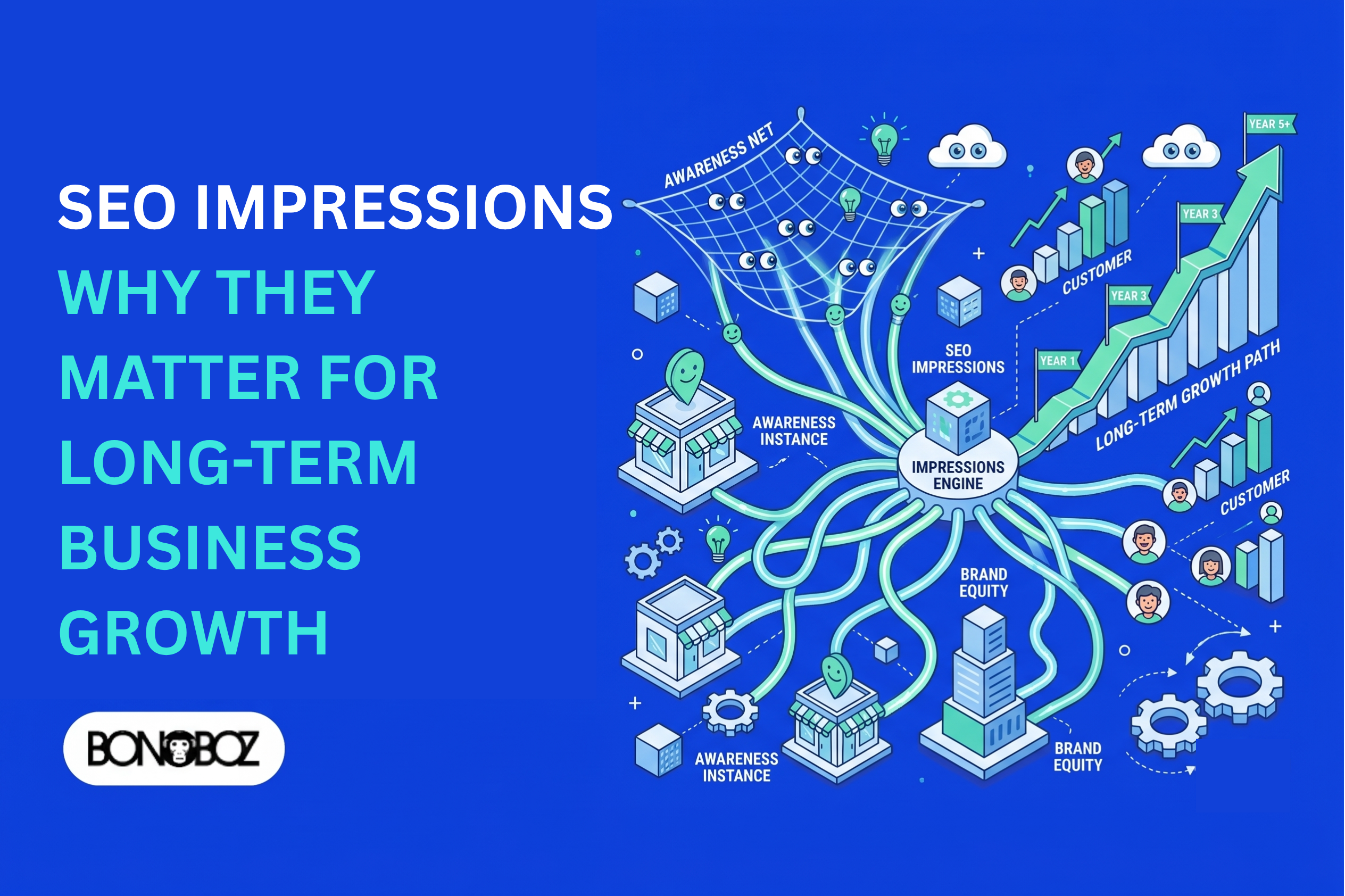
Most business owners in India have seen the standard agency performance report: a line graph pointing upward, paired with claims of massive organic growth. Yet when you look at your inbox, sales pipeline, or revenue, nothing has changed.
In many cases, the agency is highlighting impressions. An impression simply means your website link loaded on a user’s Google search results page. The user may have scrolled past it, ignored it, or clicked on a competitor. Tracking seo impressions is useful, but only when you stop treating search appearances as actual traffic, leads, or business growth.
This guide breaks down how to measure search visibility realistically, without falling for vanity metrics. By reviewing SEO impressions alongside clicks, position data, and conversions, you can identify real content gaps and make sensible decisions about your website.
Key Takeaways
- Search visibility indicates potential reach, but it does not guarantee website visits or qualified leads.
- Monitoring search appearances helps identify missing content and relevant query opportunities.
- An impression only records when your link loads on a search page, not whether a user paid attention to it.
- Comparing impressions against clicks and conversions reveals whether your search traffic is actually qualified.
- Consistent audits prevent digital marketing reports from relying on vanity metrics to show progress.
Why SEO Impressions Matter for Long-Term Business Growth
SEO is not just about holding the top spot for a single keyword. It is about building steady visibility across queries your potential customers actually use. Analyzing impressions shows where your site appears, though appearances alone do not prove user interest or commercial success.
Define SEO impressions in plain English
An impression occurs when a page from your site appears in search results for a user’s query. The user does not need to click for the impression to count.
Understanding the role of impressions in seo means recognizing that a search engine counted your link in the background. It indicates potential reach, not confirmed engagement. Users often scroll past listings or choose another result, which is why visibility data must be analyzed alongside actual site traffic.
Separate impressions from clicks, rankings, and conversions
Marketers frequently blur these metrics together in monthly reports:
- Ranking (Position): Where your page sits on the search result page.
- Impression: A record that your page loaded on the user’s screen.
- Click: A user choosing your link and visiting your website.
- Conversion: A visitor taking a defined business action, such as filling out an inquiry form or completing a purchase.
When evaluating an impression seo report, remember that high visibility with minimal clicks usually points to irrelevant search queries, unappealing page titles, or poor search placement.
Explain how repeated visibility builds familiarity and trust
Appearing consistently for relevant searches can build brand recall over time. However, search visibility is not an automatic trust signal. Credibility depends on page quality, clear positioning, accurate information, and your brand’s actual reputation. High visibility will not salvage a poor user experience or an unhelpful landing page.
Connect search visibility with sustainable business growth in India
For growing businesses in India, tracking search visibility highlights where audience demand is moving across local and national markets. Used correctly, impression data serves as an early diagnostic tool to refine keyword targeting and content strategy—not as proof of revenue growth.
Step 1: Establish What an SEO Impression Tells You
Impressions are a starting metric, not a measure of business success. Understanding what they record helps you interpret search engine data accurately.
- Identify when pages appear in Google search results: An impression is logged when an eligible search result appears on a user’s screen. It does not guarantee the user read or noticed your listing.
- Explain how one query can generate impressions for multiple keywords: A single page can appear for dozens of related search variations as search engines interpret intent and topic context.
- Distinguish impressions from organic traffic and user engagement: Analyzing impressions seo performance measures presence on Google’s search page, whereas traffic and engagement measure user actions on your actual website.
- Why an impression does not require a website visit: An impression only requires that your link loaded. Users can—and frequently do—select a competitor’s link instead.
- How search result position influences impression value: An impression at position #3 carries far more commercial value than an impression at position #19, even though both register as a single appearance in standard reports.
Step 2: Set the Right SEO Impression Baseline
To evaluate search performance, measure it consistently over an adequate timeframe. Comparing short-term spikes distorts performance.
- Choose a realistic measurement period for the first comparison: Use a 60- to 90-day period to establish a baseline. This smooths out short-term fluctuations, seasonal dips, and minor algorithm updates. Log major site changes or campaign launches so you do not mistake technical fixes for shifts in market demand.
- Record impressions by page, query, device, country, and search type: Break down Google Search Console data by specific dimensions. Mobile search behavior in tier-2 Indian cities often differs significantly from desktop search patterns in metro areas.
- Compare branded and non-branded search visibility: Separate searches for your company name from non-branded searches for general solutions. Branded impressions reflect existing awareness; non-branded impressions show overall market discovery.
- Separate local search data from national and international SEO data: If your business serves specific cities or regions, evaluate local visibility independently. Combining local and national numbers obscures regional performance trends.
- Account for seasonality, algorithm updates, and major SEO changes: Document external factors like seasonal demand or Google updates. Review impressions, clicks, CTR, and average position together to get an honest picture of performance.
Step 3: Track SEO Impressions in Google Search Console
Google Search Console (GSC) provides raw performance data directly from Google. Organize this data around clear business questions rather than isolated numbers.
[Google Search Console]
└── Performance Report
└── Search Results View
├── Filter by: Query, Page, Device, Location
└── Evaluate: Impressions + Clicks + CTR + Average Position
- Open the Performance report and select the Search results view: Log into Google Search Console, select “Performance” in the side navigation, and choose “Search results.”
- Filter data by queries, pages, countries, devices, and dates: Segment your data to isolate specific product categories, high-priority landing pages, or local geographic areas.
- Review impressions alongside clicks, click-through rate, and average position: A page with thousands of impressions but a 0.2% CTR usually indicates a mismatch between user intent and your search snippet, or a ranking position too far down the page.
- Use comparison periods to identify meaningful growth: Compare the current period against the previous year or quarter to identify actual trends rather than normal week-to-week noise.
- Export reports for deeper analysis and client communication: Export raw data to spreadsheets to analyze query groups and isolate true performance trends from vanity metrics.
Step 4: Use Google Analytics to Connect Visibility With Behavior
High impressions mean your site is visible, but they do not show what users do after clicking. Connect search data with Google Analytics (GA4) to assess real engagement.
| Metric Type | Tool Source | What It Measures | Business Value |
| Search Impressions | Google Search Console | How often your link loads in search | Measures potential search exposure |
| Organic Clicks / Sessions | Search Console / GA4 | Visitors arriving on your site | Measures actual site traffic |
| Engaged Sessions | Google Analytics 4 | Visitors staying to consume content | Measures audience interest |
| Conversions | Google Analytics 4 | Leads, form fills, or purchases | Measures real business outcomes |
- Link search visibility with organic sessions and landing page engagement: Compare impressions with organic sessions. If visibility rises but visitors leave instantly, your search snippet made a promise the landing page failed to deliver.
- Track whether impression growth produces qualified visitors: Visibility for broad, generic keywords may inflate your impression metrics without driving inquiries or business leads.
- Compare organic search behavior with other digital marketing channels: Evaluate organic performance alongside paid search and direct channels to understand where your most valuable leads originate.
- Measure engaged sessions, conversions, and conversion rates: Focus on key events like contact form submissions, WhatsApp clicks, or quote requests rather than relying on session counts alone.
- Recognize when high impressions create traffic but little business value: A blog post might pull high impressions and clicks for general informational queries, but if those visitors never convert, the commercial value remains low.
Step 5: Diagnose Low Click-Through Rates From Strong Impressions
When impressions are high but clicks remain low, investigate the mismatch rather than dismissing the data.
- Find pages with high impressions but weak click performance: Identify pages in Search Console with substantial impressions but low click volume. Check their average position first; ranking near the bottom of page one naturally yields fewer clicks.
- Rewrite title tags to match search intent and improve relevance: Craft titles that clearly describe what the user will find on the page. Avoid generic statements or corporate buzzwords.
- Strengthen meta descriptions without relying on keyword stuffing: Write concise meta descriptions explaining the practical value of the page. Focus on clarity rather than squeezing in repeated keywords.
- Align search snippets with the content users find on the page: Ensure your title, meta description, and page content make the same promise. If a searcher clicks expecting a pricing guide, that information should be easy to find.
- Test clearer value propositions, local references, and stronger language: Test specific, clear value propositions and track performance changes over 30 to 60 days before making further adjustments.
Step 6: Turn Impression Data Into Better SEO Content
Impression data highlights the topics Google connects with your site. Use this information to improve page depth and structure.
- Use search queries to discover content gaps and new topics: Look for queries generating impressions where your site lacks dedicated, clear content. These represent direct audience interests.
- Build pages around related terms and multiple user intents: Group search queries by underlying user intent instead of creating thin, separate pages for slight keyword variations.
- Update content that earns impressions but no longer answers the query: Refresh outdated pages that earn search appearances but fail to convert visitors into readers or leads.
- Improve headings, internal links, examples, and calls to action: Structure pages with clear headings, contextual internal links to related services, and practical calls to action.
- Use keyword research to expand content without sacrificing readability: Add relevant details and address related questions naturally, maintaining clear, readable prose.
Step 7: Improve the Technical Foundations Behind Search Visibility
Technical SEO ensures search engines can crawl, index, and evaluate your content effectively. Unresolved technical errors limit search eligibility.
- Check crawling, indexing, canonical URLs, and URL structure: Verify that primary landing pages are indexable and free from accidental noindex directives or canonical loops.
- Improve mobile usability and page experience across devices: Ensure your site loads quickly and functions smoothly on mobile devices, where most search activity occurs.
- Use structured data to help search engines interpret page content: Implement relevant schema markup to give search engines explicit context about your pages, products, or locations.
- Resolve duplicate pages, broken links, and accidental noindex directives: Audit your site periodically to fix broken links and eliminate duplicate URL paths that confuse search crawlers.
- Coordinate on-page, off-page, and technical SEO improvements: Align technical cleanup with content updates and genuine authority building rather than relying on a single technical fix.
Step 8: Evaluate SEO Impressions Across Local, National, and AI Search
Search interfaces continue to evolve. Evaluating performance requires looking beyond broad national averages.
- Measure local visibility for businesses serving Indian cities and regions: Segment impression data by region or city when location influences customer demand. Cross-reference GSC data with Google Business Profile metrics.
- Compare Google Search performance with broader organic search results: Recognize that sponsored ads, map packs, and featured snippets share search space with traditional organic links.
- Prepare content for answer engines, AI search, and generative engine optimization: Search engines increasingly highlight direct answers. Focus on clear, structured content that addresses specific questions directly.
- Use clear answers, trustworthy sources, and structured content: Format core information clearly, cite reliable sources where appropriate, and use proper heading structure.
- Track changing search behavior instead of relying only on traditional rankings: Monitor overall traffic, inquiry trends, and conversion data alongside rank tracking to adapt to changing search habits.
Step 9: Turn SEO Impression Trends Into a Long-Term Growth Strategy
Long-term planning relies on evaluating steady trends rather than reacting to daily fluctuations.
- Prioritize pages with rising impressions and strong conversion: Allocate resources to pages that demonstrate both search visibility and lead potential.
- Build SEO reports that explain business outcomes, not vanity metrics: Structure reporting around qualified leads, pipeline impact, and organic conversion rates, treating impression data as a background diagnostic.
- Set quarterly targets for visibility, traffic, leads, and revenue: Establish realistic quarterly benchmarks that connect reach improvements with conversion expectations.
- Use trend lines to guide content strategy and link-building decisions: Base content updates and internal linking priorities on multi-month visibility patterns rather than short-term keyword changes.
- Avoid reacting to short-term fluctuations with unnecessary SEO changes: Allow search engines time to process site updates before making additional, disruptive changes.
Step 10: Apply an Evidence-Based SEO Impressions Strategy
An evidence-based strategy treats search impressions as an indicator of search engine indexation, not business growth.
- Why SEO impression trends matter for ongoing optimization: Visibility trends confirm whether search engines recognize your site’s topical focus, providing a baseline for content refinement.
- Combine Google Search Console, Google Analytics, SEO tools, and human analysis: Cross-reference search appearance data with site analytics and real business outcome tracking to get a complete view.
- Connect impression growth with keyword ranking, organic traffic, and conversions: Verify that visibility gains eventually lead to increased site visits and qualified business inquiries.
- Adapt reporting for local businesses, growing companies, and enterprise SEO: Match your tracking complexity to your business scale, prioritizing geographic clarity for local operations and broad category trends for enterprise sites.
- Use evidence-based optimization instead of guesswork or isolated ranking claims: Focus on sustained performance trends across queries and landing pages rather than unverified promises or isolated ranking wins.
Tracking search impressions reveals how often your business appears in search engine results before a user clicks. While visibility is a necessary first step, it must be evaluated alongside clicks, organic sessions, target audience relevance, and actual conversions.
Focus on what happens after your site appears in search. Building steady search visibility only creates real value when it brings qualified visitors to your site and generates measurable business leads.
Frequently Asked Questions
1. What exactly is an SEO impression, and why should I care if nobody is clicking yet?
An impression is recorded whenever a link to your website page loads on a search engine results page. It indicates that Google categorizes your page as relevant to that search query. While impressions do not equal site visits, rising visibility is often an early indicator that your content updates or technical changes are being processed by search engines.
2. If my impressions are sky-high but my clicks are low, is my SEO strategy failing?
Not necessarily, but it requires investigation. Low clicks relative to high impressions usually stem from a low search position (bottom of page one or page two), unappealing page titles, or ranking for broad queries that do not match user intent. Review your search positions, snippet text, and query relevance before declaring the strategy a failure.
3. How does an SEO strategy distinguish between local search visibility and national SEO performance?
Local search visibility focuses on geographic-specific queries (e.g., “accounting firm in Pune”), whereas national SEO targets broader, non-location-specific terms. In Google Search Console, you can filter performance data by country or state, and evaluate local map pack visibility separately from national organic listings.
4. Can technical SEO issues prevent my pages from earning impressions?
Yes. If search engine crawlers cannot crawl or index your pages due to noindex tags, broken canonical tags, robots.txt blocks, or severe site speed issues, your pages will not appear in search results, resulting in zero impressions.
5. How do AI search and generative engine optimization change the way we look at impressions?
AI-driven search features and direct answer panels synthesize information directly on the search page. This can lead to zero-click searches, where users get their answer without clicking a link. In these cases, traditional impression numbers may remain stable while click volume changes, making it even more critical to measure brand engagement and conversions rather than clicks alone.
6. Why prioritize impression trends over a single keyword ranking?
Tracking a single keyword ranking gives a narrow and often misleading view of performance, as rankings vary by user location, device, and search history. Tracking total impression trends across a broader set of related queries shows whether your overall search reach is expanding.
7. How long does SEO take to start showing significant impression growth?
Timelines depend on site authority, competition, technical health, and content quality. For established websites, initial impression growth from content updates can appear within 4 to 8 weeks. For newer domains or highly competitive sectors, building steady search visibility often takes 3 to 6 months of consistent work.
8. Does social media or off-page SEO influence my search engine impressions?
Social media activity does not directly generate Search Console impressions. However, off-page efforts that build site authority and referral interest can help search engines crawl and index your pages more effectively, indirectly supporting search visibility over time.
9. What tools should I use to connect search visibility with actual user behavior?
Use Google Search Console to track search appearances, queries, clicks, and average positions. Connect this with Google Analytics 4 (GA4) to evaluate user session duration, page engagement, and goal conversions once visitors land on your website.
Related Articles:
- FAQ Schema for SEO: How It Works and How to Implement It
- SEO for Fashion Ecommerce: Strategies to Drive More Organic Sales
- What Are Backlinks? A Practical Guide to Link Building for Indian Brands

Rahul Mamtani
Rahul is an SEO Expert with over 6 years of experience in search engine optimization, helping businesses improve their online visibility, organic traffic, and search rankings. His expertise includes technical SEO, keyword research, on-page and off-page SEO, local SEO, and content optimization. He focuses on data-driven strategies and practical SEO solutions that help websites attract relevant audiences and achieve sustainable organic growth.