
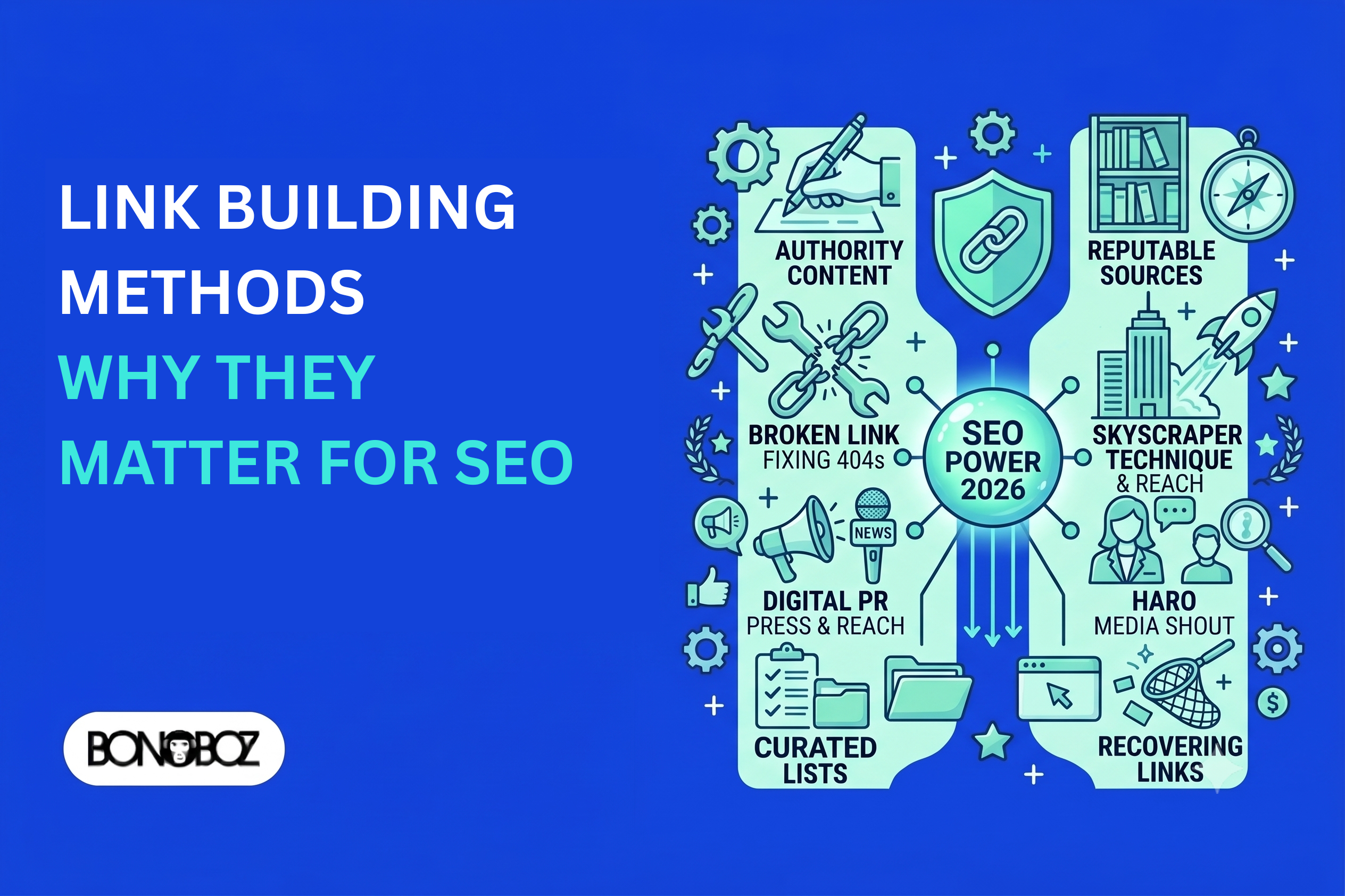
Most business owners we talk to at Bonoboz have been burned by digital marketing packages promising rapid rankings through high-volume link building. The typical result is a report full of high-Domain Authority (DA) metrics from obscure websites, zero increase in qualified leads, and occasional search engine penalties when algorithm updates roll through.
The reality of search engine optimization in 2026 is simple: search engines care about domain context, editorial trust, and user intent. Unrealistic promises about quick link counts usually signal low-quality practices. At Bonoboz, we are also following this practical approach for all of clients who have taken our SEO Services to ensure long-term stability and actual business value.
Here is an honest breakdown of the off-page Link Building Methods that build lasting authority, how they work, and what you should realistically expect from them.
Key Takeaways
- Contextual relevance and source credibility matter significantly more than total link volume or manipulated domain scores.
- Search algorithms easily flag link networks, automated outreach, and cheap guest post farms.
- Sustainable authority requires building useful web assets, providing original data, or earning real editorial mentions.
- Off-page effort should focus on driving qualified industry traffic, not just inflating vanity metrics.
The Current State of Link Building in 2026
Modern search engines are far better at recognizing natural web connections than they were a few years ago. Algorithms evaluate whether a link makes sense within the context of the surrounding content and whether the referring site has real human traffic.
A reliable seo link building strategy relies on earned placement rather than bulk acquisition. Acquiring five links from active, respected sites in your specific industry will systematically outperform fifty links from generic blogs created solely to sell placements.
Many low-cost agencies still rely on link networks or automated mass emails to secure placements quickly. While these tactics might yield short-term movement on low-competition keywords, they expose your domain to penalty risks during core algorithm updates. Building a clean backlink profile takes more effort up front, but it protects your search visibility over time.
Why Link Building Strategies for SEO Remain Essential?
Despite continuous updates to search algorithms, external signals remain a core factor in how search engines judge credibility. Off-page optimization acts as a system of third-party verification. When authoritative websites reference your content, search engines interpret that signal as a vote of confidence.
Implementing structured link building strategies for Organic SEO Services helps establish your brand’s presence in competitive markets where on-page optimization alone is not enough to stand out.
Without relevant external citations, search algorithms struggle to differentiate your site from hundreds of competitors publishing similar content. However, authority is built step-by-step through consistent, targeted effort rather than short-cut campaigns.
1. Digital PR and Brand Mentions
Digital PR focuses on earning coverage in recognized industry publications, news outlets, and trade journals by sharing relevant commentary, company developments, or original insights. It is a highly effective link building strategy because it aligns directly with search engine preferences for organic, editorially-approved references.
Unlike traditional PR, which focuses purely on awareness, digital PR combines storytelling with search objectives.
Key Benefits of Digital PR:
- High-Trust Authority: Earns citations from established publications that low-tier link vendors cannot access.
- Referral Traffic: Directs interested readers from relevant articles straight to your website.
- Brand Protection: Builds a resilient footprint that helps your domain weather search algorithm changes.
When publications reference your brand name or business leaders without linking back, a straightforward outreach request can often convert those unlinked mentions into active backlinks.
2. Strategic Guest Posting on Authoritative Domains
Guest posting remains a valid approach when used for genuine industry contribution rather than low-tier link placement. The goal is to publish well-researched, useful articles on platforms that your target customers actually read.
Using guest posting as one of your primary link building tactics requires strict criteria for platform selection:
- Verify Audience Engagement: Ensure the target blog has real readers, active comment sections, or natural social shares.
- Focus on Relevant Topics: Write about subjects directly connected to your core expertise.
- Prioritize Reader Value: Draft articles that solve specific problems rather than promotional pitches.
- Use Contextual Anchors: Integrate references naturally within the body of the article where they add genuine context.
Avoid sites that publicly advertise guest post sales or accept articles on completely unrelated topics. Search engines easily identify these link marketplaces and ignore or penalize the links coming from them.
3. Leveraging Broken Link Building for Quick Wins
Broken link building is a utility-focused method centered on finding dead links (404 errors) on respected industry sites and offering your active content as a replacement.
Because webmasters want to maintain a clean user experience on their own sites, bringing a broken link to their attention provides mutual value.
Process for Execution:
- Identify well-established resource pages or articles in your sector.
- Run technical checks to spot non-working external links.
- Ensure you have a relevant, high-quality article or guide that matches the context of the broken link.
- Reach out to the site owner with a brief, helpful note explaining the broken resource and suggesting yours as an alternative.
While conversion rates on cold outreach are typically modest, the links acquired through this method carry high contextual relevance.
4. Creating Linkable Assets and Data-Driven Content
The most cost-effective long-term tactic is producing assets that other content creators want to reference on their own. When you publish proprietary survey data, industry statistics, or functional tools, other writers will naturally cite your pages as source material.
Integrating this approach into your broader link building tricks creates an engine for organic backlink growth that requires less manual outreach over time.
Examples of Effective Linkable Assets:
- Original Industry Reports: Surveying local business trends or regional benchmark metrics.
- Free Calculators and Templates: Functional tools (e.g., ROI calculators, budget templates) that solve immediate daily tasks.
- Clear Data Visualizations: Infographics or charts that simplify complex technical topics for easy sharing.
- In-Depth Case Studies: Real-world breakdowns detailing operational challenges, implemented solutions, and measurable outcomes.
5. Resource Page Outreach and Industry Directories
Resource pages and professional directories are designed specifically to organize useful links for site visitors. While general web directories are largely obsolete and treated as spam, curated trade directories and regional business hubs remain valuable for link building for seo.
Focus exclusively on platforms that maintain strict editorial standards:
- Official industry association directories.
- Regional chambers of commerce and business registries.
- Curated lists of specialized tools, suppliers, or service providers.
When suggesting your site for inclusion on a resource page, clearly explain how your content helps their audience solve a problem. If the list is outdated, you can also point out dead links while offering your site as a fresh addition.
6. The Power of Skyscraper Content Techniques
The skyscraper approach involves identifying popular content within your sector, analyzing its shortcomings, and creating a significantly more comprehensive or updated version.
When sourcing link building ideas, evaluate existing top-ranking articles in your niche. Look for information gaps, outdated statistics, or poor formatting, and address those gaps in your own piece.
Once your upgraded resource is published, reach out to site owners currently referencing the older or less complete versions. Present your piece as an updated alternative for their readers.
7. Building Relationships Through Influencer Collaboration
In a B2B context, influencer collaboration isn’t about paid social media endorsements; it involves partnering with respected industry practitioners, consultants, and platform leaders.
Collaborative content naturally leads to shared links and wider distribution across niche professional networks.
Practical Steps for Co-Creation:
- Invite industry specialists to contribute short quotes or insights to an upcoming report.
- Host expert roundtables or video interviews and publish transcribed summaries on your site.
- Co-author deep-dive industry guides with complementary, non-competing businesses in your sector.
When external experts participate in creating content, they are far more likely to link to the final piece from their own websites or personal blogs.
8. Link Reclamation and Unlinked Brand Mentions
Link reclamation is often the fastest way to earn high-value placements because it targets websites that already know your brand.
As your business grows, publications, news outlets, and blogs will occasionally mention your company, products, or key executives without including a hyperlink. Identifying these mentions and requesting a contextual link requires lower effort than cold outreach campaigns.
This systematic approach remains one of the most reliable seo link building strategies for growing brands:
- Set up tracking alerts for your brand name, key executives, and proprietary products.
- Filter new web mentions to separate editorial features from directory listings or forum chatter.
- Review the mentioning page to verify that adding a link improves the user experience.
- Send a polite, concise request to the editor or author thanking them for the feature and asking if they can turn the text mention into a clickable link to your site.
How Bonoboz Implements These Tactics for Our SEO Clients?
As one of the Top SEO Agency in India, we don’t use hidden networks or make empty guarantees about ranking overnight. We are also following this practical, direct approach for all of our SEO clients, ensuring that every outreach effort aligns with real business targets rather than vanity numbers.
By prioritizing contextual quality over link volume, we ensure that your backlink growth translates into real domain authority, resilient search rankings, and qualified referral leads.
Grounded Takeaway
Building domain authority does not require high-volume link schemes or vague agency promises. Sustainable search visibility is earned by systematically publishing useful content, engaging with genuine industry partners, and securing links from websites that your audience already trusts. Focus on relevance, protect your brand’s reputation, and measure success by lead quality rather than raw link counts.
FAQs
1. What is link building, and why does it matter for SEO in 2026?
Link building is the process of getting other websites to hyperlink back to your site. Search engines treat these links as votes of confidence. In 2026, quality and relevance matter far more than sheer volume; a few links from authoritative, industry-related sites do more for your rankings than hundreds of low-quality placements.
2. What are the best link building strategies for SEO used by Bonoboz?
We focus on methods that yield long-term results without penalty risks: digital PR, manual outreach for strategic guest placement, creating proprietary data assets, link reclamation, and broken link building. We tailor the combination based on client resources and market competition.
3. How does a broken link building strategy work?
Broken link building involves scanning relevant websites in your industry for dead links (404 pages). Once found, you contact the site administrator to notify them of the broken resource and suggest a page on your site as a logical replacement.
4. Why should I avoid buying links from low-cost packages or link farms?
Cheap link packages usually place your site on network domains created solely to sell backlinks. Search engines easily identify these patterns. Using them can result in algorithmic penalties, lost traffic, and wasted budget.
5. How does digital PR help earn high-quality backlinks?
Digital PR uses press releases, data stories, and expert commentary to secure coverage in legitimate publications and news outlets. Editors link to your site as the source of the story, resulting in high-authority, natural backlinks.
6. What are unlinked brand mentions, and how does link reclamation work?
An unlinked brand mention occurs when a website references your company name, executive, or product without adding a working hyperlink. Link reclamation is the simple process of contacting the author or editor to request that they turn that text mention into a link.
7. How do you choose the right anchor text for incoming links?
Anchor text should look natural and fit the surrounding content. We avoid over-optimizing with exact-match keywords across every link. A healthy backlink profile uses a clean mix of branded terms, specific page titles, and natural contextual phrases.
8. Is guest posting still an effective way to get backlinks?
Yes, provided it is done for genuine editorial value. Writing insightful, well-researched content for respected blogs in your niche builds industry relationships and referral traffic. Writing low-quality posts for sites that sell placements, however, is ineffective and risky.
9. How does Bonoboz track the performance of off-page SEO efforts?
We avoid tracking just vanity metrics like total link counts or artificial DA scores. We monitor keyword position trends, organic traffic growth to target pages, backlink retention, and ultimately, qualified lead generation.
10. Why is content marketing essential for a sustainable link building strategy?
External sites need a clear reason to link to you. High-quality content—such as original research, useful tools, and comprehensive guides—provides that value. Without strong content, acquiring links requires significantly more effort and yields lower success rates.
Related Articles:
- Why SEO Impressions Matter for Long-Term Business Growth?
- What Are Backlinks? A Practical Guide to Link Building for Indian Brands
- 2016 to 2026: How SEO Has Transformed Over the Past Decade
