
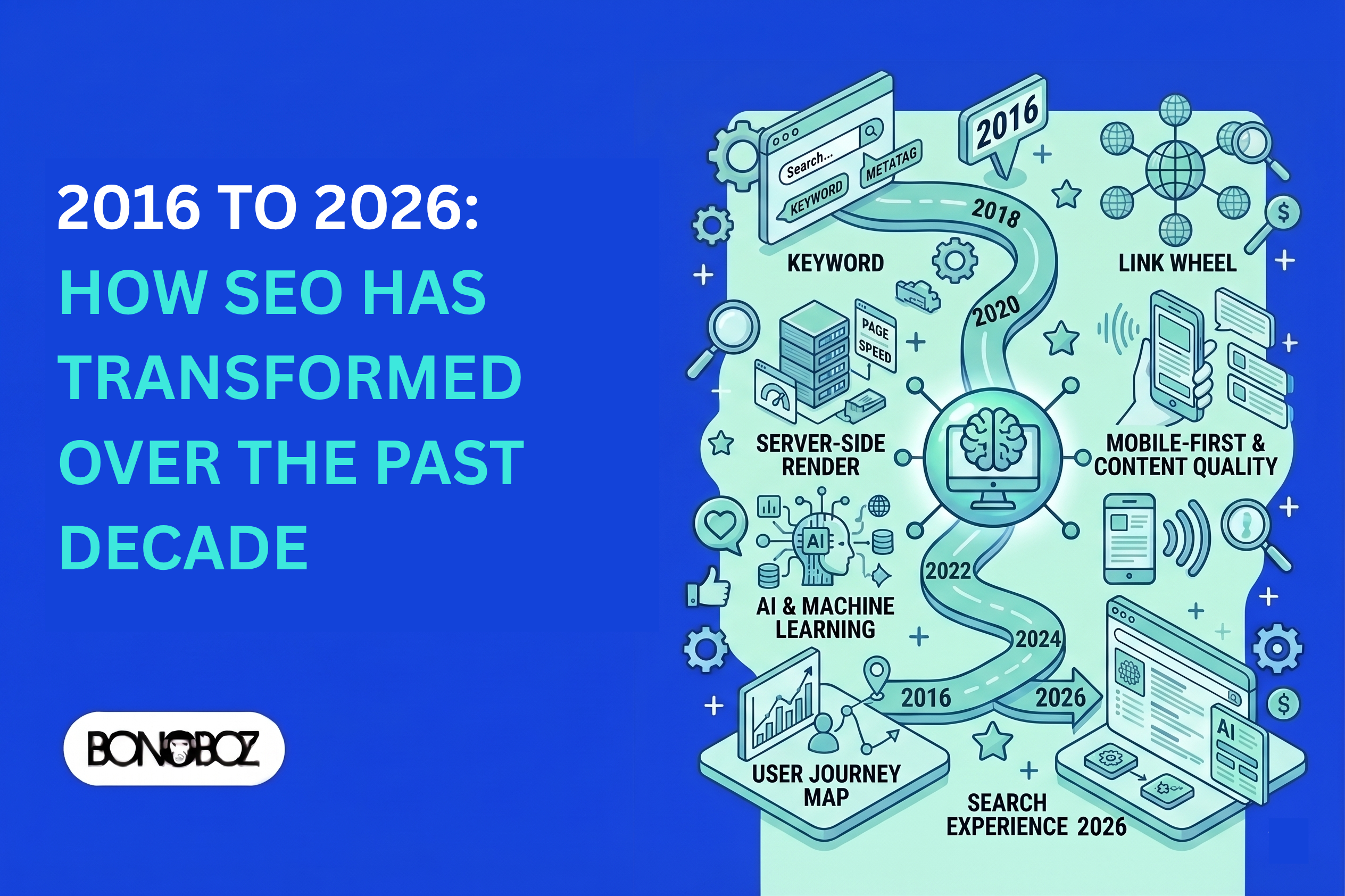
Digital marketing in India has experienced a quiet but drastic shift over the last decade. Back in 2016, many agencies sold SEO as a mechanical checklist: buy a stack of directory links, stuff a target phrase onto a page, and watch the rank tracker move.
Today, that approach fails completely. You may still receive monthly agency PDF reports showing green arrows and higher rankings, but if your phone isn’t ringing and your sales team isn’t closing deals, those metrics are meaningless. Modern search engines and AI tools have fundamentally altered how buyers find businesses. Understanding these shifts is necessary if you want organic channels to produce real business revenue rather than just site visits.
Key Takeaways
- Search strategies have moved from mechanical keyword tricks to proving actual domain expertise.
- High traffic numbers mean little if the visitors coming to your site have no purchasing intent.
- Artificial intelligence and zero-click search results require brands to optimize for direct answers, not just clicks.
- Sustainable search performance requires clear positioning, fast site performance, and verified subject matter authority.
- Long-term growth comes from solving customer problems, not trying to outsmart search platform updates.
The Landscape of SEO in 2016: Keywords and Backlinks
Looking back at the state of seo 2016, the industry relied heavily on volume over substance. Agencies often promised page-one rankings in thirty days using shortcuts that ignored customer experience entirely.
The typical strategy involved creating dozens of thin pages targeting minor spelling variations or hyper-specific phrases, regardless of whether a real human would enjoy reading them.
The Dominance of Keyword Stuffing and Exact Match
In 2016, exact match keyword placement was standard practice. Websites frequently repeated awkward search phrases across headers and paragraphs just to hit arbitrary density percentages.
Common tactics included:
- Forcing exact-match search terms into page titles, URLs, and footers regardless of readability.
- Buying exact match domains to gain an artificial advantage in search results.
- Creating duplicate pages for slightly different location phrases without changing the underlying offer.
- Hiding extra target phrases in accordions or bottom page blocks purely for crawler visibility.
The Era of Link Building and Quantity Over Quality
Backlinks were treated as a simple numbers game. Many business owners paid agencies for thousands of low-cost links sourced from irrelevant directories, link farms, and private blog networks.
Agencies reported link counts as a metric of success, even when those links came from sites with zero real traffic. This created short-term ranking spikes, followed by complete visibility drops when search engines eventually flagged the activity.
Technical SEO Limitations in 2016
The discipline of search engine optimization 2016 platforms required was fairly primitive compared to modern standards. It focused primarily on basic crawlability rather than user performance.
Agencies limited technical work to:
- Making sure crawlers could index basic pages.
- Submitting static XML sitemaps to webmaster console tools.
- Maintaining standard robots.txt files.
- Fixing obvious broken links without evaluating mobile load speeds or page layout stability.
Major SEO Changes and Algorithm Evolution
Search platforms shifted from running simple pattern filters to deploying advanced evaluation systems. This evolution changed how businesses reach decision-makers across competitive markets, including India’s growing digital space.
These seo changes mean search platforms now evaluate whether a page actually satisfies a visitor’s request, rather than just matching text strings.
From Penguin and Panda to Core Updates
Early platform updates like Panda and Penguin were targeted filters designed to scrub obvious web spam and manipulative link schemes. They hit sites that relied on scraped content or purchased backlink packages.
Over time, these standalone filters were integrated into continuous core updates. Today, platform updates evaluate site quality holistically, penalizing sites that prioritize search engines over user utility.
How Google’s Search Algorithms Became Smarter
Modern search systems parse context, intent, and phrase relationships. They understand synonyms, industry jargon, and multi-step queries without requiring exact keyword phrasing.
This means a well-written page explaining a complex B2B service can rank for dozens of related search variations automatically, without the need to create separate landing pages for every phrase variation.
The Impact of Machine Learning on Search Rankings
Machine learning systems analyze real-time user behavior to refine search results. They evaluate how users interact with landing pages, whether they find immediate answers, or whether they leave to click a competitor’s link.
This real-time feedback loop rewards sites that deliver clear, immediate value and penalizes pages that rely on clickbait headlines or deceptive copy.
The Shift from Traditional SEO to User Intent
Modern search strategy focuses entirely on intent matching. The old approach of driving cold, irrelevant traffic to inflate reporting metrics no longer serves a commercial purpose.
Understanding the User Behind the Query
A visitor searching for “best ERP software pricing” has a completely different intent than someone searching “what is ERP software.” The first is an active buyer comparing options; the second is a researcher learning basics.
Structuring content around customer intent ensures you attract qualified prospects who are actually in a position to evaluate your product or service.
Moving Beyond Keywords to Topical Authority
Search platforms favor websites that demonstrate complete coverage of a specific subject area rather than isolated landing pages. Building topical authority requires addressing the full buyer journey:
- Publishing detailed resources that address common customer implementation challenges.
- Structuring content logically with clear internal links to guide readers through related topics.
- Updating core industry guidance regularly to reflect market changes and verified data.
The Importance of Content Quality and Relevance
High-quality commercial content speaks directly to user pain points with clear solutions. It avoids fluff, vague claims, and generic market speak.
When your content offers straightforward explanations and actionable steps, you build credibility with potential clients before they ever submit a contact form.
The Rise of AI and Generative Search
The search ecosystem is undergoing another structural shift driven by artificial intelligence. Traditional search result listings are increasingly supplemented or replaced by direct conversational summaries.
The Emergence of Large Language Models
Large language models synthesize information across thousands of sources to give users direct answers. Instead of browsing five different websites to compare specifications, buyers receive integrated summaries instantly.
This shift means your business needs to be cited inside these model outputs as a recommended, trusted authority in your category.
How ChatGPT and Perplexity Changed Information Retrieval
Tools like ChatGPT and Perplexity have changed user expectations around research speed. Buyers expect immediate, contextual answers tailored to their specific constraints.
Key changes in buyer research habits include:
- Direct comparison of competing vendors through conversational prompts.
- Requests for structured summaries and step-by-step implementation frameworks.
- Reduced patience for long, ad-heavy blog posts that hide answers behind walls of text.
- Increased reliance on real-time data synthesis across multiple platforms.
Google’s Search Generative Experience and AI Overviews
Google’s AI Overviews place concise summaries directly at the top of search result pages. These summaries answer common questions directly, reducing the total volume of clicks passing to third-party websites.
To remain visible in this environment, your business content must present verified facts, original research, and clear definitions that search models can easily cite.
Comparing SEO Strategies: 2016 vs 2026
The strategic focus of search marketing has fundamentally shifted over the past ten years.
| Strategic Focus | 2016 SEO | Modern Search Strategy (2026) |
| Primary Goal | High keyword ranking positions | Qualified lead generation and revenue |
| Content Approach | Exact match word repetition | Direct intent resolution and topical coverage |
| Link Building | High volume, directory links, PBNs | Brand mentions, digital PR, industry trust |
| Technical Focus | Basic crawlability and XML sitemaps | Mobile load speed, Core Web Vitals, clear schema |
| Budget Focus | Mass link packages and thin content creation | Expert content, technical performance, CRO |
Strategy Shift: From Ranking for Keywords to Answering Questions
In 2016 seo campaigns, success was measured by how many keywords reached page one. Agencies targeted broad terms with high search volume, even if those terms brought visitors who would never buy.
Today, effective strategies focus on answering specific customer inquiries thoroughly. Winning a smaller volume of highly targeted, high-intent traffic yields far better commercial returns than capturing thousands of generic visitors.
The Evolution of SEO Spend and Resource Allocation
How companies assign their marketing budgets reflects this structural seo change. Historical seo spend 2016 allocations directed money toward buying low-tier backlinks and cheap article rewriting.
Modern budgets prioritize domain experts who can write authoritative material, technical developers who optimize site performance, and user experience designers who turn landing page visits into qualified leads.
Adapting to Zero-Click Searches and AI-Driven Visibility
Zero-click searches are an established reality. When search engines answer user questions directly on the results page, overall website click-through rates decline for informational terms.
Adapting requires building brand authority so strong that when users are finally ready to purchase, they search for your company by name rather than relying on generic category terms.
Technical SEO and E-E-A-T in the Modern Era
Technical precision and brand trust form the baseline for modern organic performance.
Why Experience, Expertise, Authoritativeness, and Trustworthiness Matter
Search engines place heavy emphasis on Experience, Expertise, Authoritativeness, and Trustworthiness (E-E-A-T), particularly for businesses offering high-consideration B2B services, financial products, or healthcare solutions.
Trust is the foundational requirement for digital lead generation. Without proven expertise and business credibility, pure technical optimizations rarely produce sustainable sales inquiries.
To build meaningful domain trust:
- Highlight first-hand industry experience, case studies, and real client outcomes.
- Include clear author bios with verifiable professional credentials.
- Maintain complete business transparency, including clear pricing indicators, physical contact details, and client testimonials.
- Secure authoritative brand mentions from respected industry publications and business directories.
Core Web Vitals and User Experience Metrics
Technical SEO now centers heavily on user experience. Core Web Vitals measure real-world performance: how fast your content loads, how quickly the page becomes interactive, and whether visual elements shift around while loading.
If your website takes five seconds to load on a mobile device in a Tier-2 city, visitors will leave before ever reading your headline. Fast, stable performance directly protects your conversion rates.
Optimizing for AI-Powered Search Engines
AI-driven search engines require clear data structures to parse page content accurately. Using structured schema markup helps crawlers identify your product offerings, client reviews, corporate address, and publication details without ambiguity.
A clean site architecture ensures both human visitors and automated crawlers can locate essential information without friction.
Local SEO and Google Business Evolution in India
Local search across India has grown rapidly as mobile connectivity expands into Tier-2 and Tier-3 commercial centers.
The Growth of Local Search Queries in India
Business owners, procurement teams, and consumers increasingly use localized searches to source nearby suppliers, services, and physical storefronts.
Search queries now frequently include explicit location parameters or rely on device location to find immediate, verified local partners.
Optimizing Google Business Profiles for Local Visibility
For local and regional businesses, a verified Google Business Profile often drives more direct leads than a corporate website landing page.
To maximize profile performance:
- Maintain accurate operating hours, service categories, and contact numbers.
- Gather genuine customer reviews consistently and respond to them professionally.
- Upload photos of your facility, team, and projects regularly to build buyer confidence.
- Post regular updates regarding new services, offers, or operating changes.
Voice Search and Conversational Queries in Regional Languages
Voice-assisted queries in regional languages—including Hindi, Tamil, Telugu, and Marathi—represent a growing share of local searches across India.
These queries are naturally conversational and longer than typed searches. Structuring FAQ sections around plain-language questions helps capture this regional search demand effectively.
The Future of Search: AI Overviews and Answer Engine Optimization
Search optimization is evolving into Answer Engine Optimization (AEO). The goal is ensuring your brand’s data and insights are built into the answers provided by AI search platforms.
Transitioning to Answer Engine Optimization
AEO focuses on structuring information so AI engines can easily read, summarize, and cite your content. This requires clear content formatting, concise summary sections, and unambiguous facts.
How Marketers Can Stay Relevant in an AI-Driven World
To protect your organic pipeline:
- Stop publishing generic, high-level articles that offer no unique insight.
- Conduct original industry surveys, share proprietary data, and publish real project outcomes.
- Focus on late-stage buyer intent where buyers need direct consultation, custom quotes, or complex solutions that AI cannot provide.
Synthesizing Content for Generative Engines
Structure key informational pages logically. Start sections with a direct, single-sentence summary of the answer before providing supporting context, background data, and implementation detail.
This structure allows AI tools to pull clear snippets while giving human visitors the depth required to make informed purchasing decisions.
Conclusion
The evolution of search from simple keyword matching to AI-assisted answer engines reflects a shift toward rewarding genuine business value. Tactics that worked a decade ago no longer yield commercial returns.
For Indian SMEs and growing brands, success in organic search comes down to fundamentals: clear market positioning, fast digital infrastructure, documented domain expertise, and a sharp focus on qualified business inquiries over vanity traffic metrics.
FAQs
1. What are the most significant seo changes between 2016 and 2026?
Search has evolved from mechanical keyword placement and mass backlink purchasing to understanding user intent and context. Modern search systems prioritize direct answers, fast mobile load speeds, verified domain expertise, and clear content quality over superficial ranking tricks.
2. How did recent core platform updates change the ranking landscape?
Recent core updates increased the emphasis on original experience and operational trust (E-E-A-T). Websites relying on low-quality, automated content or manipulative link strategies saw major visibility declines, while established businesses with clear domain authority gained organic share.
3. What is Answer Engine Optimization (AEO) and why is it important now?
Answer Engine Optimization involves structuring content so AI systems—like Google AI Overviews, ChatGPT, and Perplexity—can easily parse and cite your information. It matters because more users now accept direct AI summaries rather than clicking through multiple search result links.
4. How has seo spend 2016 evolved compared to current marketing budgets?
In 2016, budgets were frequently wasted on cheap, automated link packages and thin content farms. Modern search budgets are directed toward subject matter expert writing, technical performance optimization, conversion rate improvements, and custom digital PR.
5. How do AI-generated search overviews affect organic website traffic?
AI Overviews answer many basic informational questions directly on the search results page, reducing total traffic for high-level informational keywords. However, the traffic that does click through to your website often carries higher buying intent, leading to better overall conversion rates.
6. What role do conversational AI tools play in modern search research?
Tools like ChatGPT and Perplexity allow users to ask complex questions and evaluate vendor options conversationally. Maintaining clear data structures and authoritative online mentions ensures your brand is accurately represented in these AI-driven research workflows.
7. Is local SEO necessary for businesses operating in regional markets?
Local SEO is critical for regional visibility. Optimizing your Google Business Profile, collecting authentic customer reviews, and accommodating regional language search patterns allows local businesses to capture high-intent inquiries from nearby prospects effectively.
8. How can a business ensure long-term organic growth in an AI-driven search market?
Focus on creating unique value that AI cannot replicate: publish proprietary business data, share real case studies, maintain fast and secure web performance, and optimize your entire user experience around turning site visitors into qualified business leads.
Related Articles:
- Why SEO Impressions Matter for Long-Term Business Growth?
- What Are Backlinks? A Practical Guide to Link Building for Indian Brands
- 8 Link Building Methods That Work in 2026 and Why They Matter for SEO
